Friday, November 14, 2014

Albi & Toulouse-Lautrec

Taken from the bus to Albi, one of the few remaining roads in
France, intentionally planted with "plane" trees to provide shade for drivers.

Our second day in Toulouse, we decided to take a bus to Albi, a small city about an hour north, where Henri Toulouse-Lautrec was born. His best friend, art dealer Maurice Joyant, and mother, the Comtesse Adele Toulouse-Lautrec, created a museum in Albi that houses the largest collection of his work in the world.

The Toulouse-Lautrec
museum and gardens
The museum is housed in an estate that belonged to his family, the Palais de la Berbie, next door to the cathedral of Sainte-Cecile, on the banks of the Tarn river. It was a true fortress with thick walls, lovely gardens, and classic medieval architecture.

Henri was born to wealthy parents and had an excellent education. But because his parents were first cousins, he had some genetic problems which resulted in easily broken bones. After both legs were broken in his childhood, they didn't heal properly and quit growing. He never reached an adult height.

Also, and maybe due to his deformities, he had an emotional affiliation with people on the fringes of society, like prostitutes and cabaret performers. Much of what he is known for are the portraits of dancers and brothel workers in their off-hours, when they spent time together, eating, talking, or just waiting for customers.

But in the museum there are numerous other portraits, drawings, and lithographic stones of famous aristocrats, advertising posters, flyers, and menus for restaurants. What impressed us so much was that his style borders on the cartoonish, but the faces of his subjects, the only thing that really mattered, were executed with sensitivity and skill. He had a true love of horses and painted many in various attributes, alone, ridden, harnessed, in circuses. Although he only lived to be 36, he was prolific in his output.

Some overhanging buildings!
We were not allowed to photograph inside the museum, but the collections are online at this website:  Toulouse-Lautrec

This time of year, many museums close between noon and 2:00. So we had lunch, wandered the gardens, and did the river walk. It's a beautiful little town with ancient bridges and medieval buildings. Some of the oldest buildings have upper stories that overhang the first because in medieval times, you paid taxes only on the square footage of the ground floor! In the center of old town, a new market has been built with a full service grocery on the ground floor and many independent butcher, chocolate, and bread shops on the upper floor. Modern as it looks, it fits with the character of the town, and boy are the pain de chocolats at the bakery good!!


The Tarn River and Albi 
Beautiful old bridge, still in use.
Inside the new market


Tuesday, November 11, 2014

Toulouse


Toulouse

Toulouse river walk
My friend Tom lived in France for over a year and often raved about a baked bean dish called cassoulet. Toulouse and a couple of nearby cities are the Mecca for cassoulet lovers, though according to writer Ann Mah, they are all virtually made the same way with the same ingredients these days. Long ago, various wild game birds and animals had been incorporated to give different flavors, but now those animals are scarce. 

It is a famous dish in a dish, a special crockery bowl, narrow at the bottom and sloping up to a wide mouth at the top. The key to a great cassoulet is to assemble the ingredients, and then without ever stirring, bake it again and again until it’s done, preferably over a two or three day time frame. The beans should be creamy and firm, not mushy, and the meats should be soft. It is made from haricot beans, actually a legume brought to Europe by Columbus from the New World. Prior to his discoveries, cassoulet was made with lima beans (yuk!) The haricots were so superior that societies sprang up to protect the strains of beans to keep them pure, and then other societies evolved to bestow medallions and awards upon chefs and restaurants that made the best.


The name Restaurant Emile kept coming up when we were looking for the best cassoulet in Toulouse. So we went there at 10am to get a reservation. They were closed. Posted in the windows was a Michelin emblem, and about a dozen awards over a number of years from several different Cassoulet Societies.  We returned at one minute till noon and entered the tiny restaurant (an illusion, as the restaurant occupied two floors of the building!)

There were several formula options, where you pick from a selection of starters, then main courses, and desserts for a fixed price. We asked if we could go ala carte and just share a cassoulet. We started with a small carafe of good Bordeaux and shared a plate of ravioli stuffed with foie gras du canard in a sauce of boletus mushrooms and cream. Every bite was incredibly good, and we mopped up the sauce with hunks of baguette.

Then the cassoulet, in a traditional casserole bowl, was brought to the table. Normally just one person eats the whole thing, but it would have been impossible for either of us to be that person. As Tom said, it’s hard to imagine beans being so good or so expensive! He was right, they were perfectly done, and the flavors were bits of goose, sausage, bacon, garlic, onion, and any number of other flavors I couldn’t put my finger on. But they were truly the best “beans” I’d ever eaten.

Dessert was a beautiful little chocolate cake called a moulleux, with nuts on top, sitting on a swath of chocolate fudge, and at the other end of the swath was a scoop of blood orange glacee topped with a curl of lacy caramel. The cake had a warm molten center that was nothing like the pudding so many lava cakes are made with. It was more like a melted semi-sweet chocolate bar.

Joyce and I have gone native. We took two full hours to savor every bite of that incredibly good and very expensive lunch, just like most of the diners around us.

Afterwards, full but not stuffed, we hiked around in the beautiful sunny day. There are several bridges, and some remnants of an old one, similar to the Pont du Avignon. Walks along the river are shaded by tall “plane” trees with white trunks and fluffy little seedpods.

The Augustine Museum of Fine Art, housed in an old monastery, has a wide range of paintings and sculptures. We only saw half of it, as it was closing just about when our feet gave out. Many of the sculptures were exquisite and it had a good collection of both older religious paintings and more modern impressionists. We appreciated the large plasticized cards for each section, written in several different languages, that explained the paintings and lives of the painters.
 
Augustine Museum
Earlier in the morning, while waiting for the restaurant to open, we were directed to a palace, the Capitole du Toulouse. While most of it has been remodeled into offices, some of the more exquisite rooms are open to the public. An entire room is devoted to the post-impressionist Henri Martin, whose monumental paintings fill a large hall. Another beautifully painted room is rented for weddings and ceremonies. A third, the most elaborate of all, is used for official gatherings. It is filled with sculptures in every niche between the tall windows that overlook the large plaza. The high ceilings are plaster friezes with paintings of angels and people reaching up to them, and every square inch of wall is decorated in some fashion. 

Henri Martin Hall in the Capitole, Huge paintings!
That tiny person is Joyce.


While we only spent one full day in Toulouse, it was one of the more memorable days in France. It deserved a longer visit. We barely scratched the surface.


Mirrors behind allow appreciation
of the full range of the sculptures
in the Capitole.

Hall where the city fathers meet weekly

Interesting architecture, this
is an apartment building and under
the plaza is a major shopping center.

The neighborhood of Restaurant Emile


Avignon and the Palais du Papes

Pont du Avignon & Palais du Papes

We purchased four sets of train tickets to finish out our trip around France, once we settled on the dates and where we'd like to go. At the Gare Part Dieu in Lyon, a young man whose English was good, with a very American accent, helped the ticket seller figure out the best routes for our plan. He had never been to America, he learned English from watching US movies all his life!

We decided on a week in Avignon, a small city on the banks of the Rhone, almost at its mouth on the Mediterranean. In the 1300s, it had been the Holy See, the seat of the Catholic Church, and the move caused huge rifts within the Church. Apparently the first French Pope hadn't felt very safe in Rome so he purchased the entire city of Avignon, remodeled it in less than ten years and moved in. Eight other popes, all French I believe, followed after him over the next 100 years.

The story behind the purchase is fascinating. Joanna (Joan) Queen of Naples had been accused of conspiring to murder her husband. She was also the ruler of large swaths of land in what is now France. In order to purchase a sufficiently large indulgence (and protection) from the Pope, she agreed to sell her rights to Avignon for a relatively cheap price. She was later found innocent and cleared of all charges.  

Pope Clement V built a thick wall around the city, a palace on the hillside, and enlarged the existing church, where two popes are buried today. In addition to the Palais du Papes, there is the Petite Palais, a massive building, but smaller than the castle, which was originally home to cardinals, and later became an administrative center. It is now a museum that houses many religious works, some by famous artists like Sandro Boticelli.


Guard tower of the Palace & the church
topped with a golden statue of the Virgin Mary

The gardens overlook the Rhone valley in that part of Provence. In the distance on a clear day you can see the tall foothills of the Alps. On the other side of the river is a fort & castle belonging, back in the 1300s, to the King of France, who afforded some protection to the Papal See. A long bridge connected the two castles, called Pont Bénézet. It was named for the sheepherder who had a vision where an angel told him to go down from his home in the hills and convince the people to build a bridge. According to the legend, he was a scrawny little fellow who (with the help of angels) picked up a huge block of stone that had been too heavy to move when the Palais was built, and placed it right where the bridge should begin. That was miracle enough to convince the Pope and the people in the area to build the bridge. Now it is the Pont du Avignon, and all that is left of the huge bridge are four arches and a small chapel, dedicated to mariners, built on the side of one of the support piers. The tower that anchors it to the river’s edge is a museum with an ongoing video describing the legend, efforts to stabilize what is left, and a project to digitally rebuild it in its entirety for future visitors to enjoy.

The city has many lovely attractions: a huge indoor market with plants growing up the outside walls (called Les Halles); a free ferry across the Rhone to an enormous park with paths all round for pedestrians, bicycles, skateboarders and picnicking families; excellent restaurants featuring local produce and recipes; and a large shopping area in the center of town on closed streets where our favorite store, Jeff de Bruges, was located (an out of this world chocolate shop!)

We stayed a week, could have stayed a month. Avignon is a perfect location to explore nearby towns. The train station is right across from the walled city gates, and trains leave constantly for other parts of France. 

Model of the Palais 
Sandro Boticelli's painting of
Mary and baby Jesus

Jesus' bris, the only painting of that event
I've ever seen 

St. Michael slaying a demon

View from the Palais gardens across the river to Fort St. André

Inside Les Halles market, piles of flavored salt!


Saturday, November 8, 2014

Arles, Still Roman After All These Years

Details of the amphitheater

Arles is an old Roman town almost at the mouth of the Rhone River. It was an important settlement, outpost, and trading center. Now, it’s still a Roman town, with the Colosseum in use for sporting events and concerts. The old amphitheater is an outdoor museum and though the Forum buildings are
gone, its large open courtyard is the center plaza of the town.

The horse race track has been paved over by a road, but the center parts of it are still visible in the open field in front of the archaeological museum. The small inner city is surrounded for the most part by the original Roman walls. You must pass through gates to enter, and some are just barely wide enough for the small European cars. There’s a lot of car paint on the walls and corners of the gates.

We stayed in Avignon for a week, and on Sunday decided to take the local regional train to Arles. With a late start we didn’t see as much of the old city as we’d like. However, since it was the first Sunday of the month, all the museums were free! It was such a small city that we crossed it, from museum to train station, in less than 25 minutes, hoofing it to catch the last train.

The courtyard of the mental hospital
Arles is also known as the last place where Vincent Van Gogh lived and painted. He worked prolifically, creating over 200 paintings. Today there is an entire society devoted to him. The members have placed a copy of each painting at the spot where he probably stood to paint it. There are dozens of easels all over the town and out in the countryside, but unfortunately, there is not even one Van Gogh original in the city.

We happened to pass the hospital where he spent his last two years in a mental asylum, now converted to apartments and shops. The garden and the portal are essentially the same. I suspect they keep it that way so the easel with the painting still matches the scene.

During his stay, Van Gogh’s doctor allowed him to go out daily to paint in the areas around Arles. The locals objected to a loose mental patient, but after a while, when all Vincent did was paint or perhaps act strangely from time to time, they got used to it. His paintings never were popular until many years after his suicide.

The archaeological museum is extensive. The emphasis is on the Roman settlement, and the best displays are the models. In plexi-glass cases are detailed and large models of the city, the Colosseum, the river, and that unique Roman invention, the floating bridge. The public bathhouse which was several stories tall, looked like an emperor’s villa.
Model of the floating bridge, ingenious!!


In a long deep recess, there is a complete Roman barge that sank in 53AD into the Rhone. It was discovered by divers and exhumed only a few years ago at great expense. All of the cargo was intact and much of it is on display: dozens of tall ceramic amphora that once held wine or olive oil, heavy ingots of lead and copper, large chunks of pearly white limestone for facing buildings, and the personal effects of the crew. The rudder, the wooden-metal anchor, and the body of the boat are in amazing condition.

The museum also houses a number of funerary objects, carved marble sarcophagi, busts, sculptures, and beautiful swaths of tile inlay scenes that once graced the floors of elegant homes.

If we’d had more time we would have searched for the Van Gogh easels, and explored more of the Roman buildings that are still in use. Arles was a step back into several points of time, a real treat for someone who travels to learn.

Model of Arles in 50 AD

Brilliant solution to the need for shade at the Colosseum

The well preserved Roman barge in the museum


Saturday, November 1, 2014

Around Lyon

My friend Joyce and I spent five days exploring Lyon. It's easy to do with its good metro and bus system. We stayed in a hotel near the Gare Part Dieu, the main TGV train station. From there, a number of buses and trolleys run in all directions.

Vieux Lyon, or Old Lyon is west of the two rivers, the Saone and the Rhone. Dominating the area is the beautiful Notre Dame Basilica. Just down the hill a short distance are two Roman amphitheaters, now restored and used in summers for concerts. The subway goes beneath both rivers and quickly takes people from one side of the city to the other.

Roman fountain, Hotel de Ville in background
In Old Lyon, the buildings are ancient stone edifices with narrow streets, mostly closed to traffic now, crammed with shops and restaurants with apartments above. Across the Saone, the town is newer, only several hundred years old. The city, with the Hotel de Ville as it's center, is "downtown." Here, in an old convent, is an impressive art museum that took five hours to explore. The opera house and many wide spacious plaza's overlook the Rhone.

And going east across the Rhone, the city is newer still, extending for miles with modern skyscrapers and industrial zones. It is the third largest city in France.

At a curve in the Rhone, the city has built a beautiful park, Tete d'Or. Many acres of forest, fields and lake are bordered by the river to the west and north, and a large university on the east. It was a beautiful place to spend the day wandering the many paved and unpaved trails.

Elaborate ornamentation of the Hotel de Ville

The Lyon Opera House

Saone River between Old Lyon and the City Center

Looking up at the Notre Dame
Basilica from trails in the park below

Parc de la Tete d'Or

War monument on the island: Ile de Souvenir
Sculpture at the entrance to the park


Lyon: Food Capital of the World

If France has the reputation of being the foodiest country, in terms of variety, cooking styles, and innovation, then Lyon, which all Frenchmen say is the best, is surely THE food capital of the entire world.

And we ate there for 5 days. And ate and ate.....

Fortunately we walked and walked too.

Andouillette!!
Lyon is the third largest city in France. It has a decent metro, augmented by buses, electric trolleys, and two funiculars.

I try to plan trips the easy way. Get where I'm going, plan the next phase on then go. In the autumn, which is off-season, that's easy. The entire trip is more intuitive, and changeable. But it backfired in Lyon. I tried several requests on AirBnB and got zero answers. So we stayed in a hotel found on Booking.com, for one night. It suited us. It had a micro kitchen and was centrally located. We stayed for five days. But having learned a good lesson, we booked the whole rest of France, trains and lodging until the end of our stay.

Inside Notre Dame Cathedral
The first full day we took the metro to Old Lyon, and rode the funicular, which is on the same ticket as the Metro, up to the Notre Dame Basilica. It is almost as spectacular as the one in Paris, but built at a somewhat later time when technology had gotten better and there was no need for flying buttresses. Filled with religious paintings and sculptures, it also has an inlaid tile floor that was impressive. Overlooking the entire Rhone Valley is a golden statue of the Virgin Mary.

Just down the hill is a Roman ruin dating to pre-Christian times. It consisted of two amphitheaters, both restored and in full use all summer as an outdoor music and theatrical venue. The antiquities museum is housed next to it, half buried in the hillside with tubular windows to let in the light. It houses a huge collection of Roman sculpture, rescued frescoes, and inlaid tile scenes.


Amphitheaters

Lyon was once Lugdunum, a major Roman trading post since it was situated at the confluence of the Rhone and Saone rivers. The old city is atop massive roman ruins, buried in part by the annual flooding of the rivers, which are now more or less controlled, and the usual knock-down and build techniques of human beings over the entire planet.

We walked through narrow streets with tiny zooming cars, down into Old Lyon at the bottom of the hill. It was packed with tourists, every restaurant was full with a line out the door. We picked one with a menu in only French and stood in line. Finally we were seated and slogged our way through the offerings. A few fast questions in English and French were asked of the poor sweating waiter who was working hard, dealing with far too many tables. One of the items was andouillette sausage, something I'd read about but didn't remember why it was touted as so wonderful. We bought the midi-lunch, a salad, main course and dessert.

Each course was a meal in itself. Two medium sized boiled potatoes with a very salty fish atop, with sour cream and onion topping, and a side serving of greens almost filled me up. The main course was the sausage, boiled, sitting in a creamy mustard sauce, with a good serving of potatoes au gratin and a puree of carrots. More greens rounded out the real estate on the large plate.

I cut the sausage. It burst open to reveal large chunks of meat, herbs, and steam. It smelled heavenly and it was. Each bite was an explosion of flavors. We ordered a Cote du Rhone red wine to go with the meal. Each sip seemed to cleanse my palate so that every bite of that meal was like the first one.

Then dessert. I thought to order the chocolate mousse, but they were out of that. Instead I was offered a tiny chocolate cake with a dusting of powdered sugar sitting in a pool of caramel. It wasn't a lava cake, but probably the lava cake's ancestor recipe. Gooey and warm inside, almost liquid it was like eating a warm dark chocolate bar with cake texture.

Joyce had a fish en croute with a nice cream sauce in a ramekin. Her salad was Lyonaise, a bed of greens with hunks of baked bacon and a boiled egg, topped with herby dressing. Her dessert was a custard, a bit like flan but loaded with tiny flecks of vanilla.

We hurt. We actually ate too much because it was so good we couldn't stop! And the bill, about $50 for the two of us, didn't hurt at all. We'd kind of gotten used to paying that much in Paris for meals that were only half as good.

Later that evening, I went to a party given by some people I'd met in Los Alamos years before. Freddy and Mariepierre live on the 9th floor of a building overlooking the amphitheater ruins, with views to the east and south down the rivers. Out her large kitchen window, the Notre Dame Cathedral was set like a painting, all lit up with floodlights.

One of their friends is an American who married a Frenchman and has lived for 30 years in France. When I refused food at the party because I was so full from lunch, she eagerly asked where we'd eaten and what. When I told her, she expressed shock and awe. I'd eaten Andouillette and lived to tell about it? She couldn't stand the smell and just the thought of eating intestines grossed her out. I assured her, it was one of the best meals of my life.


Tile floors at Notre Dame


Thursday, October 30, 2014

Paris: The Marais

I am a big fan of slow travel, go to a place, rent an apartment for a week (or a LOT more) and see what is interesting. Plus just meander about and peek into alleys and corners. Any city will have so much more to experience that you'll ever read about in a travel guide or on the Internet.

My friend Joyce and I rented an apartment on AirBnB. The owner was a Canadian woman, about 35 years old, who has lived in France for over ten years. Jane owned the apartment/condo in the Marais neighborhood, but decided to move in with her boyfriend and rent out her somewhat smaller space. It was a large room with a high ceiling. A platform over the kitchen and bath served as the loft bedroom.

The kitchen was a 2-butter, so small that two people crash butts all the time!! But it was well stocked, the knives were sharp, the water very hot and it allowed us to purchase fresh food and make delicious breakfasts. It was a perfect situation.

We arrived mid-afternoon after an all-night plane ride and a weird traverse of Paris' train and metro system. Weird only because we were so tired and it was confusing. Fortunately, we discovered, as we would again and again, that Parisians are lovely, helpful, and polite people. Several times someone who spoke English well came to our aid and rescue.

So our first job was to locate a market and purchase food for a few days. We walked right past the grocery story several times because it looked like a department store with a bakery on the side. The grocery section was hidden in the back!

We wandered around the Marais, which is the 3rd Arrondisement (ah-roan-dees-mont), or neighborhood, out of about 16 total in Paris. Joyce had a packet of cards, each one a different walking tour of Paris. We followed the directions to the Place de Voges, once the home of the king, and then later on Victor Hugo. His home is a museum which we enjoyed very much, as well as a nice meal in one of the sidewalk restaurants under the portal (which I'm sure has a better name in French.)

Place de Voges

Marais is just north and east of the center of Paris. If we'd had a month we could have walked all over it, and found good routes to the Louvre, the Notre Dame Cathedral, etc, but being short on time and foot-energy, we opted to use the metro. One of the best in the world, for a mere 1.50 Euros, you can get from one side of Paris to the other in just a few minutes.

At the northern tip of the Marais is La Republique, a metro station, huge plaza surrounded by expensive stores, and a center of city activity. Down the broad Boulevard du Temple is the Bastille. No longer a prison, nor even a building, it is now simply a monument inside a huge roundabout. But the area bustles with activity, sidewalk cafes, and stores. Centralized shopping areas are like glowing spots on the map with apartment buildings packing up the space in between.

Just around the corner from us was a busy street with nice little restaurants and a wine store where Joyce and the young handsome clerk fell in love. He helped us pick excellent wines for several days straight, then said he wouldn't see us for a few days. We would be gone before he got back, and I swear he had a tear in his eyes when he said he would miss us!!

Monument at the Bastille

Colorful & Tasty Macarons

Stained glass canopy in one of the fancy restaurants

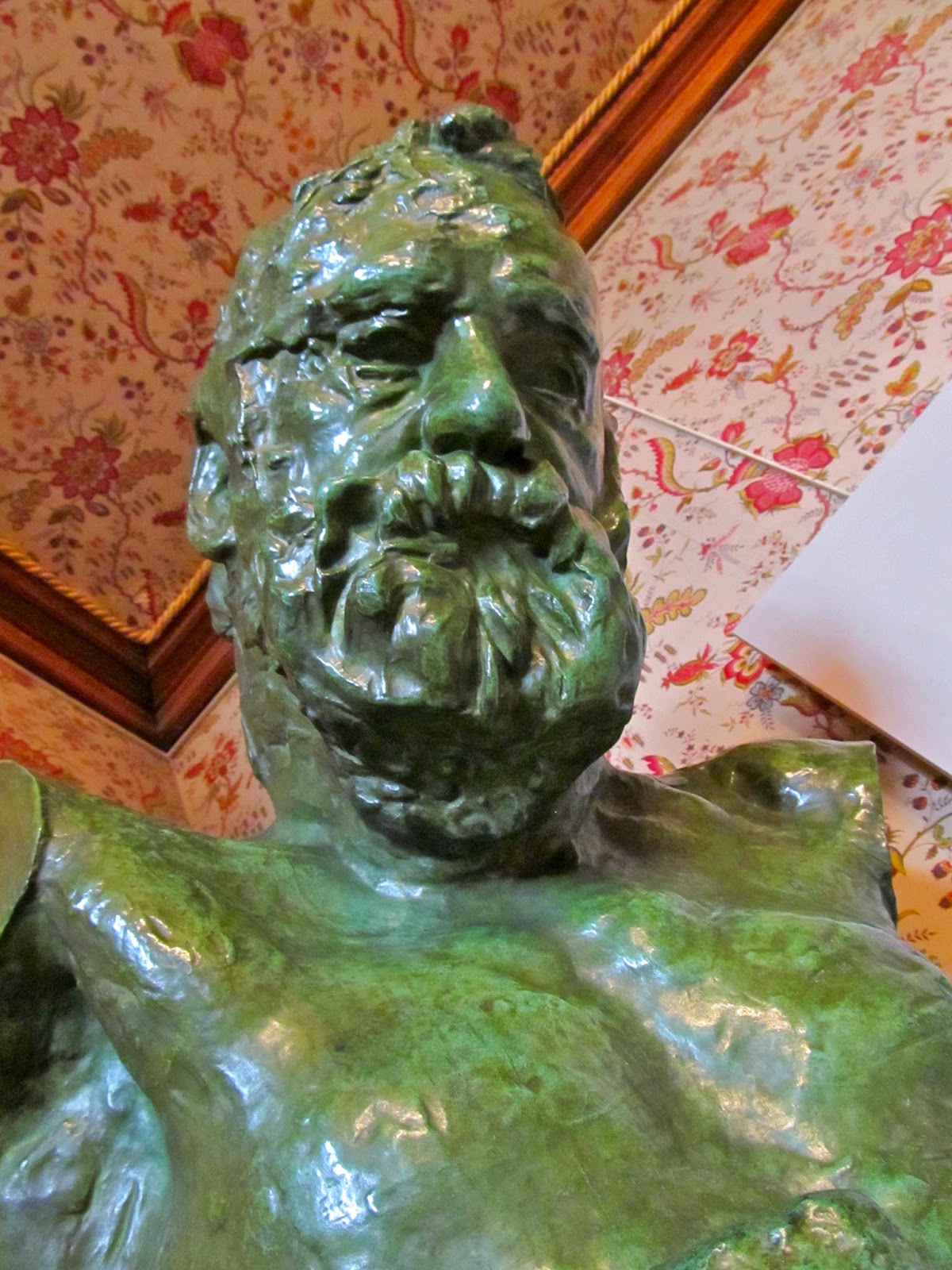
Victor Hugo, by Rodin