Sunday, March 18, 2012

Big Mexico: Coming out of Batopilas Canyon

Typical Tarahumara home in Batopilas Canyon
Wednesday morning, we had another of those 'stuffed' breakfasts at the Riverside Lodge, then piled into the trucks for the long ride out of the canyon. Once again, the trucks were like fish swimming upstream, most of the traffic was coming from the opposite direction. Noel proved to be a very skillful and prophetic driver. He seemed to sense when to slow down to avoid a head on collision with some big truck barreling downhill toward us on the dirt road.  Often we, or those coming towards us, could see some distance and knew that eventually an encounter would take place. Often the downhill traffic would have pulled over in some wide spot to let us pass. Sometimes we did the same, especially if what was coming resembled a gasoline tanker!

At the very top, where the road narrows down to a thread and the curves are something like snake paths in the grass with nothing but bus plunges on the downhill side, we had the scariest encounter of all.

Up ahead we could see men in camouflage fatigues, armed with assault weapons and wearing black masks that covered the lower part of their faces. They were on the side of the road. Beyond them, our fellow truck was face to face with a huge green vehicle with guns mounted on the top.

For the briefest moment, we (the tourists) thought we were about to be robbed and killed by a drug cartel, then dumped over the steep edge of the canyon to be fodder for turkey vultures. Noel was perfectly calm. He rolled down the window and chatted with the soldiers who wanted us to back up so their monster could get by. Noel commented to us that those idiots didn't know how to drive, that's why they'd gotten into this pickle. He began to back up.

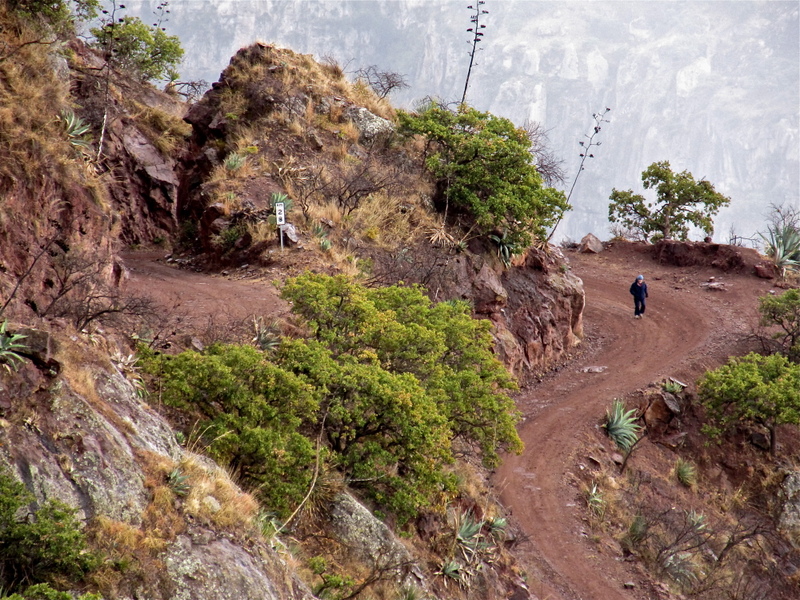
Typical of the rugged terrain
through which we drove.

Now, you have to visualize this situation. We are on the curviest of dirt roads. The drop off on the left side is hundreds if not a thousand feet, and that drop off begins inches away from the tires. Noel moved the mirrors so he could see the wheels on both sides. He frequently looked in the rearview mirror to see which way the road curved behind us. It might have been fine except each time he clamped down on the brakes, the truck slid a ways on the gravel, and enough sliding would have sent us right over the edge.  Evan and Dick were buckled into the seats on top, so I imagine they had the most frightening views, though Dick's recollection of it was fairly benign and filled with praise for Noel's skills.

At one point, Judy, watching out the back window, looking straight down the cliff, gasped. Then Felicia went white, and I wanted OUT. I said very forcefully, "I'm going to get out!!" Noel just said "no". He had locked all the doors and made no move to unlock them as he continued to inch his way backwards. I could feel my heart pounding and all I could think of was how could I get out? It quickly became apparent there was no place to go. My door couldn't have opened, the cliff face was too close, and where would I stand if I did get out? The army truck coming down was even wider than our vehicle.

Eventually the road behind widened out a bit, far enough for the army truck to pull aside and let us past, but the soldiers would have none of it. They wanted us to pull into that spot. Then I understood why. The huge truck went past us, then a jeep we couldn't have seen, and then another large white truck that the soldiers said was full of food and clothing for the Tarahumaras in the canyon. It was a relief caravan from the Mennonites with full protection from the military. Some of the young soldiers took our photo as they went past, others waved.

Somehow our sister vehicle had managed to pull aside way up ahead to let the caravan pass, so they were long gone by the time we got back to where the whole scenario started.

Meanwhile, a beautiful young Tarahumara woman carrying a baby in a sling and a load of goods in a cloth sack had walked straight up the hill on foot paths that cross over the road periodically. We had passed her a while back in the canyon, and we passed her again just a short distance from the little town at the top of the canyon.

The Sierra Lodge (the long building on the
left) and the Cusuare River.
Back in Cusare, at the Sierra Hotel, the same one we stayed at three nights before, Noel took us on a longish hike through the forest and over the hills to the cascada. A boy, about ten, joined us and was instantly hired by Noel to be our "guide", though I'm sure Noel knew his way around the area quite well. He pointed out numerous dead apple trees, an entire orchard that died because of the drought, and said he knew the people who owned it. Several fields simply lay fallow, with no crop or harvest in years.


La Cascada de Cusuare


The Cascada would usually be a roaring waterfall during the spring, but the river through there is only inches deep. There have been no snows this winter, so there won't be much of a waterfall this spring unless something drastic changes soon.

Three Tarahumara girls had set up shop on the hotel staircases, selling woven goods, necklaces, dolls, and other handmade things. Most of us didn't have small bills or change, and the poor girls didn't have money to make change with either. I purchased a few items so managed to spend my one $100p bill, about $8 US.

For dinner we had another lovely feast and returned to warm wood-heated rooms. Since we had self-assigned, Lia and I didn't get the same room we'd had. When I opened a chest drawer I found three of the cookies from the Mennonite village that someone had left earlier. Lia made sure each skinny dog around the hotel got a fair share of those cookies.


The path back to the hotel from the waterfall,
no OSHA in Mexico!!

Friday, March 16, 2012

Big Mexico: Valentine's day in Batopilas

Valentine's Day 2012

There are many reasons to want to go on a tour. One is that you don't have to plan the logistics of hotels or risk a taxi driver taking you to a really bad one out in the middle of some campo, figure out where and when to catch a bus, try to find a place where you can get vegetables to eat that aren't going to make you sick, negotiate with taxi drivers, miss out on seeing a museum because "everybody knows the museums are closed on Mondays!", etc. The bad thing about tours is that often there is a lot of sitting and being transported, and OMG how they feed you!! Every meal we had so far, and this was day five, was overwhelmingly good food and way too much of it. I felt bad several times at how much we left on our plates, and hoped at least some of it would be recycled to pigs, dogs, or even people, rather than just thrown out.

Tuesday, two more hikes were planned. The rough-n-ready hikers took off early for their 20 mile hike up to a remote canyon, while those of us nursing blisters and horrid colds went on the 6 mile ruins tour.

Ruins of the silver mill.
Batopilas has an interesting history. Way back, several hundred years ago, the Spanish Crown was interested in sucking as much gold and silver out of Mexico that it could. Every mine gave 1/5 of its output in taxes to Spain. It was carted across the ocean once a year in a huge armada of transport and gun ships to minimize the possibility of piracy. Silver was found in some abundance in Batopilas Canyon. There is a small museum dedicated to this period in history when bars of silver created at the mill in Batopilas were taken by burro and on men's backs out of the canyons to Chihuahua. It was a six week journey. Over the years photographs have been taken of the reenactments. In the museum are displays featuring photos of the mansions that were built, the mill in full swing, and the drinking establishments. The town's population was around 15,000, now it's less than 5000. There are a lot of abandoned buildings and ruins.

What is left of the mill owner's home.
Our hotel, the Riverside Lodge was one of those silver baron's homes. It had been abandoned by the original owners during the 1910 revolution when rich people fled Chihuahua. Over the years it was owned and used but was a shambles by the time an Eastern investor decided to create a luxury hotel. In the process of remodeling, three separate treasures of silver coins and paper money were discovered. One was in a floor safe, still in the living room full of silver coins, but now guarded by a 5 inch plexiglass shield. Another was found behind a wooden panel in the room Lia and I shared. In the corridor were posted details of the restoration, including a collection of old glass wine casks.

The hotel speaks of a elegant home with painted walls and ceilings, luxurious furniture, lovely outdoor spaces, and producing fruit trees. When we arrived back from our hot and dusty hikes, we were greeted with glasses of cold tart kumquat juice. Kumquats are called naranjitos in Spanish. There were at least four large naranjito trees, all drooping with small fruits. 

The rooms were elegant, the beds comfortable, and almost every bathroom had a claw-footed tub. We spent three nights at the hotel, had breakfast catered by one of the local restaurants, and went out to dinner at different restaurants every evening. We usually went to bed stuffed to the gills, but still managed to wake up to pan dulces, strong coffee, and some kind of fluffy egg dish with a variety of salsas. 

Judy peeking out her window.
The hike past the mill ruins lasted a few hours, just enough to work off some of that rich breakfast. We hiked past another large but closed hotel on the outskirts of town, past men running a water powered rock sluice filled with gold ore they'd mined in the hills. The drought has shut down all marijuana production, one of the main cash crops in the valley, so panning and mining for gold is what's left. We crossed over a suspension bridge that swayed precariously with the rhythm of our footsteps, but we were held inside by chain link fencing. Some of the boards on the bridge were missing, and in places the chainlink had large holes in it. As usual, we had to take very good care of ourselves, the nearest medical help was way up that long dirt road and all the way to Creel.  Once on the other side of the river, we followed the irrigation canal which supplies all water to the town. In places it was diverted to irrigate fields, run the gold sluice, or provide water for animals.

After the hike, some of us wandered around the town where we found an internet cafe (not open till late afternoon), several small groceries, several more bars, a lot of loose hungry dogs, and one poor old starving cow who was foraging the leaves from a tree that fell in a small park. There was no grass and nothing on the bushes.

People worked at washing clothes in the river and cutting wood out in the flats of the river bed. Some had car and tool repair businesses and there were a few stores with clothing and hardware. In general it was a small town without much going on. There was one new hotel being built. I assume the owner is hoping the new road will bring back the visitors. And the clinic was being expanded into a new hospital, so there were some publicly funded jobs to be had.

That evening we were in for a big surprise.

The hotel manager had arranged for a 4 piece band to come play for us while we had Happy Hour in the largest patio. He also furnished some locally made mescal and tequila. The mescal was exquisite, flavored and aged with raisins which mellowed it and added several layers of flavorful complexity. As it got darker, and we got drunker, we began to dance. Some of us knew the waltz, the rumba, salsa and other formal dances, but most of us simply did the monkey bouncing that we all learned as teenagers. We danced and drank for two hours. It was just delightful, and I think all of us had lost track of time, not realizing that it was Valentine's Day. Afterwards, we went for another too-filling dinner at a local restaurant. I felt very sad to leave that hotel and the sweet people of Batopilas, and knew I would really miss that luxurious bed!!


A painted ceiling in the salon.


Antique furniture is found throughout the hotel.

One of several outdoor patios, this one with a fountain.

Dining room open to the outdoors on three sides.


Part of the newer section of the hotel.
Very fanciful.
Sculptures were on display
throughout the living areas.
The hotel's lovely Mexican kitchen.

Thursday, March 15, 2012

Big Mexico: Down in Batopilas Canyon

Valley of Satevo
The guides organized two different hiking options for everyone on our tour. A older man named Manuelo, wearing street clothes and regular leather shoes took the avid hikers on a very long hike up into the mountains overlooking Batopilas Canyon. Noel took the rest of us down a dirt road leading to a small town called Satevo, famous for its Lost Cathedral.

A couple of centuries ago, all records of this church were lost in a fire, and apparently even the Catholic church forgot about it. The people of the town have kept it up and it was recently updated, painted, and repaired. It sits like a little jewel above the river.

The hike led us past the sewage treatment plant (a particular interest of mine, best not to ask why...) for Batopilas. Sewage is piped to a rectangular concrete containment basin full of sand where it percolates through. The water dribbles out through cracks in the side and down into the river. It's a major step above the usual Mexican practice of dumping sewage into the nearest ravine or river, and probably does a pretty good job due to the Mexican practice of not flushing toilet paper. There were many trees and bushes growing in that basin.

One of many goats along the path.


Noel says the fuzzy things will ripen
into very delicious fruits.

Felicia looking into a capilla.


Rudimentary stock pen.


Unfinished home on the side of a hill.

We went past stockades for livestock, many native plants and trees which Noel was exceptionally good at identifying, and the homes of local Tarahumara people. Often families would walk past us, dressed in their usual colorful clothing, the men sometimes bareskinned in loincloths and tunics. They were always friendly and Noel addressed them in their native language. His grandfather is Tarahumara and is still alive at 96 living way up on a hillside with one of his daughters, near Batopilas. Noel said it takes four hours to hike up to their house, so he and other family members go there only a couple times a year.

Satevo is a survival town. There is no market and just a tiny tienda selling staples and junk food. It was a relief for us, after three hours of hot hiking to down a cold soda. There were many abandoned homes and some well-cared-for small houses, but no sign of a business other than growing food in orchards and small plots. Donkeys, goats, chickens and sheep were more numerous than people. In the school yard a teacher was drilling some boys in basketball.

The Lost Cathedral
The church was locked but Noel asked around and got a key so we could go inside. It was simple and white, benches pushed aside, with hand crafted saints and primitive ladders leading up to the choir loft and bell tower.

Back in town, some of us went to Carolina's, a small restaurant in the old plaza that served up the best seafood soup many of us had ever tasted. The town seems so depressed, and Carolina's husband, who is running the place while she works in Chihuahua, said they are barely staying afloat. There are so few tourists anymore, some days they only have two or three customers. Business is down more than 75% due to the drought and lack of foreigners. It's a clean beautiful town and has such potential, it's awful to see it going downhill.


Inside the church, signs of devotion.

Abandoned homes in Satevo.


Looking up into the tower of the church.


Friendly donkeys looking for a scratch.


Wednesday, March 14, 2012

Big Mexico: Batopilas Canyon

The Tarahumara ladies, who made such a delicious dinner the evening before, outdid themselves with breakfast. Their biscuits, made-from-scratch and baked in a wood stove were some of the flakiest, most delicate I've ever eaten. (No offense to my mother!)  In addition they served up some delicious huevos rancheros. 

After that hearty start, we headed further down towards Batopilas Canyon, the deepest of all in the Copper Canyon system. This system is larger than the Grand Canyon and deeper. However, it's not as wide, and therefore not quite as dramatic....until you're driving on a single lane dirt road with huge trucks barreling around the corner, coming your way, and the only way around is down a 2000 foot drop off. Ah, but that's a different kind of drama.

Dick on top!
Our day started out with Dick Opsahl, our fearless leader, climbing up onto the truck. He was ready to go an hour before any of the rest of us. When you're approaching 80, you have to keep moving, and in his case, keep everyone around you moving too!

We visited another Tarahumara village called Bisihuare that featured a number of cave homes. It reminded us New Mexicans of Bandelier National Monument, where the Puebloan ancestors lived in villages partially embedded in natural caves along the south facing walls of Frijoles Canyon. 

It was Sunday and people were on their way to Mass at noon, walking into town from miles around. It is a Tarahumara tradition to run, they are famous for their ability to go long distances running barefoot or with leather and old tire sandals. But mostly the people we saw were walking, usually carrying babies and loads of goods. 

Basihuare is a substantial town with a large boarding school, church, some small stores, and a large area of scattered homes surrounded by fields and orchards. An almost dry river runs through it which is used for irrigation and laundry. 

We hiked around a bit, saw the church and visited with a few locals before reboarding our trucks and heading on down towards Batopilas Canyon.

We'd been told we would have lunch at a scenic spot, so we all expected to hike down some trail and be given a sack lunch with a burrito or a sandwich with some potato chips and a bottle of pop. Imagine the surprise when both trucks suddenly turned off the paved road and headed down a single-lane rutted dirt track for half a mile to arrive at a beautiful spot set up with a long table, white table cloth, cutlery, dishes and wine glasses! We were amazed and delighted. And our lunch was a sumptuous feast cooked over a wood fire on a specially made metal grill. The meat dish contained bacon, sausage, beef, onions, peppers, tomatoes, and lime juice. In addition the men baked quesadillas with cheese and chile on the flat part of the grill, and served guacamole with totopos (corn chips) and a good Chilean wine. 


Our little picnic spot featured an amazing vista out into Batopilas Canyon. The day was cloudy with fog hanging in the lower valleys giving the view the sense of depth and distance that it deserved. 


Looking down into Batopilas Canyon.


Back on the paved road it wasn't long before we could see the latest government efforts at widening and improving the road. Huge machines were removing pieces of the mountainside shoving the tailings out and down to create a wide smooth path. We were routed onto a narrow dirt passage with a spectacular drop off on the passenger side. I mentioned the phrase "bus plunge" and was promptly asked not to use that term again!  The view down, straight down, way down......about 2000 feet, was spectacular. A tiny stream trickled through the bottom of that deep canyon, but in fact the whitish ripples were rapids on a fairly substantial river. "Bus Plunge" really was the perfect descriptor. 

Our little dirt track widened out slightly to become a winding, twisting single lane road that inched its way down the side of the steep canyon. I asked Noel "What happens if a car comes in the other direction?"

View from the top of Batopilas Canyon
"We work it out." is all he said. He was calm and in full control. We all had seat belts, not that it would do us any good if we rolled over the edge. The road was dry and a bit rocky. There was good traction, so really, unless the brakes failed, we would reach Batopilas in about six hours. 

The long and winding road.....

Many opted to walk or run down the first couple of miles.


That silver sliver is a rather wide river.
Evan and Dick about to ride to the bottom
on the top of the truck. 

Century plants were everywhere.


View into the upper portion of Batopilas Canyon
The vegetation was dry, but seemed
to be surviving the drought.
Our adventure was just getting started. Apparently morning is when many vehicles enter the canyon and in the afternoon many leave to go back up.  In some places the road was wide enough for one or the other to move over to the side but a couple of times the vehicle facing us was a large commercial truck, and we had to back up. Once we rounded a curve and were almost hit head-on by a truck. Rarely was there less than a 200 foot drop on one side of the road or the other. 

Noel had explained that the crosses on the sides of the road, called descansos, are for people who died in an accident. The little structures with saints inside are capillas (little chapels) and are erected to say thank you for the survival of someone in an accident. I noted there were far more descansos than capillas. 

But we made it without a scratch. Batopilas is an interesting Mexican (as opposed to Tarahumara) town. Everything there has been carted down that treacherous road, yet the prices of food, dry goods, and gasoline was not exceptionally inflated. It has a small military base, a substantial river though drastically reduced by the drought, and a suffering economy due to both drought and fear on the part of tourists to visit Mexico. Batopilas has always been a major center of activities for tourists to Copper Canyon. Runners from around the world come here to run with the Tarahumara, take part in their annual super marathons, and the canyon is genuinely photogenic and spectacular.  People are hoping that the road widening will be completed within the year and will result in stimulating the economy. I suspect that it will line the pockets of quite a few people, and may indeed help the locals in the long run. On the other hand, I'm grateful to have experienced it in its primitive state. Next time I visit here, it just won't have quite the same thrill. 

Tuesday, March 13, 2012

Big Mexico: Barrancas de Cobre (Copper Canyon)

Saturday morning seemed to come awfully quickly. Our breakfast included the usual Mexican items: pan dulces, stiff coffee, freshly squeezed orange juice, plus an egg dish made with the leftover meat from the banquet the night before.

Eduardo, the city tour guide, had also been hired by Nichols Expeditions to take us to Creel where we would meet up with the next set of guides. Eduardo spoke English very well, and had a fondness for cookies. We stopped, north of Cuauhtemoc, to see the Mennonite museum. A large group of conservative Mennonites from Canada purchased many thousands of acres back in the 1920's to start a community. Since then, they have continued to purchase farm land and grow their 'campos'. They are incredibly prosperous, with modern homes that resemble the ranch-style mc-mansions in the Panhandle of Texas. Lining the road, all the way north, were farm implement dealerships, car dealerships, fertilizer and seed stores, just about any kind of industry you can imagine that has anything to do with farming. Most of the apples grown in Mexico are grown in this area, along with oats, wheat, corn, and other staples.
Mennonite Museum near Cuauhtemoc, Chihuahua

Many of the farms are dairies, and cheese is one of their primary exports. We stopped at a cheese factory and were impressed with how clean it was and how wonderful it smelled. Someone purchased a half kilo of fresh cheese and cut it up for all of us to sample. It had that slight squeek when you bite into it, typical of new cheeses.  The museum was full of old implements, tools and household goods. The building itself was typical of a large family dwelling, complete with pantry on the north wall full of home canned fruits and vegetables, butter churns, wood stove, and an enormous table with a bench seat (for boys) on the wall side, and chairs for the girls (who would be getting up often to serve) on the opposite side. The bedrooms were decked out with normal beds, convertible beds (a bench by day....lift the lid and it's a bed inside), clothing, decorations, Hope Chest, etc, typical of boys' and girls' rooms, plus a salon and master bedroom.

The Mennonites are still in villages all over the huge valley. Some are very conservative, others have become more modern. We visited the home of a conservative family that makes cookies the old German way. The home, yard, barnyard, and grounds were immaculate and manicured. The women still dress in puffy sleeved long dresses, gathered at the waist, with hair pulled back in a bun. The cookies were frozen and there were many kinds to choose from. Most of us purchased a few but were too full from breakfast and the cheese break to eat any. When we finally got around to trying them, they were very soft, more like small cakes and quite sweet.

In the museum, the hostess and other locals spoke German. My tour room-mate Lia is German and she had fun chatting with them in their old dialect. Most speak Spanish too, which they learn in school. Eduardo told us that the children still go only through 8th grade. From the Mennonite perspective, too much education leads young people away from the old lifestyle and religion.

The entire area from Cuauhtemoc north to Colonia Alvaro Obregon is Mennonite territory. They are also a large employer of the Tarahumaras from Copper Canyon, and they've been very generous sending food and needed equipment to those poor people who have suffered so much from the drought of the last three years. There appears to be a loving and strong sybiotic relationship between the Tarahumaras and the Mennonites.


Creel: The route to Creel was curvy and through forests resembling Northern New Mexico. Our guide Eduardo bid us farewell and turned us over to new guides, Noel and Manuel who loaded our luggage into two large vans equipped with seats on the top for spectacular viewing opportunities.


Our guides for Barrancas de
Cobre: Roberto and Noel
  
The amusing long-toed boots that
men in Chihuahua favor.


Stone Hongos
After lunch at a local restaurant, we headed down into the canyon to visit some Tarahumara villages that have been devastated by the drought. According to Noel they have received less than 6 inches of rain in the last three years!! They've lost entire apple and cherry orchards and have quit planting corn altogether since they've lost three yearly crops in a row. Their agriculture is almost exclusively dependent on the annual summer rains.

The area had some interesting rock formations in the shape of 'hongos' (mushrooms) and the second area had tall slim monoliths like standing monks in their robes. One village featured a store inside a cave where several women were selling things they'd made like wooden dolls, woven belts, toys, jewelry, and musical instruments. The area was dusty and bone dry. Dogs were skinny and worn. It's a wonder anyone is able to survive there at all.


A Tarahumara family compound.

The cave store and it's proprietress.

Little girl with her cat.
The next major stop was in a small town with a beautiful cemetery and church. It was full of people milling around waiting to receive their allotment of food from the government. It was being distributed from the front door of the church. As the newly arrived tourists we were inundated by children and young women selling crafts and chewing gum. The food consisted mostly of wheat flour, corn masa, dried noodles, dried beans, and sugar. Since most of the people had traveled by foot for long distances, it was probably beneficial that it wasn't mostly canned goods.

As the sun began to set, we drove further into the higher reaches of Barrancas de Cobre to our hotel, a primitive log building set against cliffs facing a river, near the town of Cusuare. On the way to the hotel I noticed a clinic and wondered if it might not be a good idea to talk to a doctor. I'd had several embarrassing coughing fits and worried that I might spread this horrid cold to the others in our cramped quarters in the vans.


Church where people received food.
Felicia and I went to see if anyone was at the clinic. It turned out that the clinic is also the temporary home of the doctor in residence. He was there, a tall slim man with the face of a saint. He practically gathered me into his arms and led me back to the exam room where I sat in a chair next to the desk. He never asked for my name, or any details of my health, nor did he weigh me, but he did take my blood pressure. I explained about the cold and the coughing. He shown a light down my throat and pronounced it infected, then rummaged around in some boxes on the floor for a box of pills and gathered a couple more medicines from the amply stocked shelves. He took a magic marker and slowly told me, as he made short deliberate marks on each box......"Morning, noon, evening", three marks on one box. "Morning only, then evening"....two marks on a plastic bottle. "Morning, noon, evening and bedtime", four marks on that box. I realized that my not speaking fluent Spanish may have prompted him to use the technique he probably uses daily with the Tarahumaras to make sure we all know when to take each medicine.

He refused to accept any money. "But I'm not a Mexican citizen" I said. He shook his head and replied, "This is a service of the Government." Wow. Real socialized medicine in action. How wonderful for him to be practicing where he doesn't have to fill out any forms, put information into some distant computer database, or go through all the other bureaucratic crap that Americans have to go through. I thanked him profusely and went back to the room to take one each of those medications as quickly as I could!


Our rustic hotel with kerosene lamps.
In the area around the little hotel there is no electricity, all light comes from kerosene lanterns. It's high in elevation so the nights can range from chilly to freezing. Each room had a bathroom with hot running water, kerosene lamps, and a pot-bellied stove for heat. At the end of the row of rooms was a large dining room with a huge fireplace at one end. We had 'happy hour' with wine margaritas and plenty of beer, followed by dinner with many local dishes, well prepared by our Tarahumara hostesses in their colorful dresses. Back in the rooms, someone had lit the fires and each one was warm and redolent with the smell of kerosene.


A family headed home with food for a week!

Valley of the Monks

A regular Monastery!


Sunday, March 11, 2012

Big Mexico: Chihuahua City

Arrival in Chihuahua City corresponded with La Comida, the two hour mid-day lunch and siesta. The cab driver was even headed home after he dropped me off at the hotel.  I asked him about the drug dealers, how much of a problem are they, and is it difficult to live in Chihuahua these days? He shrugged and said yes, they're a big problem, and every family is affected in some way, but in general the people don't live in constant fear. The cartels mostly kill each other, but unfortunately, some of those who get killed are related. That was reassuring since Chihuahua is the most murderous state in all Mexico.

From sweet to smoking hot!
Our hotel, arranged by Nichol's Expeditions was a beautiful B&B, Boutique Hotel San Felipe,  in the heart of the city. Fortunately I felt a bit better after sleeping most of the way on the plane, and since the tour group was off on a City Tour, I wandered around a bit looking for a place to eat. There was a seafood restaurant about a block away, so I ordered the shrimp and octopus cocktail. A nice assortment of condiments on each table ranged from benign American Catsup to raging hot habanero salsa with flames rising up the label. It was absolutely delicious and made me agree with the sign that said "To eat here is to eat in heaven itself."

Back at the hotel, I took a brief nap between coughing fits. My friends arrived and we had a nice little reunion as I'd not seen some of them in several months, including my room mate Lia. She immediately took charge of my health and gave me some antihistamines that worked amazingly fast. We took a long walk around the city. They showed me some of the sites they'd visited on their city tour including the mansion, Quinta Gameros, built by a rich man for his mistress but never lived in because of the advent of the revolution in 1910. Pancho Villa's home is now a museum too, and it was open. I explored over there while the others checked out the store across the street. I spent way too much time trying to decipher the labels on the exhibits which were in Spanish and something vaguely resembling English. The Spanish was easier to understand. The home is filled with period furniture, some of it actually belonged to Villa's widow who only died about thirty years ago. It contains the car in which Pancho Villa was assassinated, cleaned up of course! And there was the usual assortment of weapons, photos of generals, and other military paraphernalia.

The hotel had arranged for their cook to prepare a meal of local dishes for us that evening. I should have taken notes on exactly what we had but memory will have to suffice. Gorditas made of corn and stuffed with cheeses, nopales (cactus) and other vegetables lightly pickled, a spicy crumble of meats with potatoes, handmade corn tortillas, a lovely mushroom dish made with spices and tomatoes, and chile rellenos. There was something yummy for dessert but I was in overload by then.

We went to bed stuffed, tired and happy, ready for an early trip across the vast expanse of Chihuahua, Mexico's largest state, to Copper Canyon.

Saturday, March 10, 2012

Big Mexico: The longest night

I haven't posted for over a month because I've been traveling through Mexico which will be documented in a series of Blogs with "Big Mexico" in the title.

The trip almost didn't happen at all.

John and Mike came back from Palenque at the end of January with horrible colds. In our tiny house in San Cristobal, Chiapas, I ingested enough germs to take down an elephant.

Three days before the flight to Chihuahua, I came down hard. Both guys said the third day was the worst. The third day? That's when I would be flying!! Lots of sleep, fluids, kleenex, cough drops, nasal decongestant, and chicken soup couldn't stop the malaise. Time for a flight change. Oh happy days, it only cost half the price of the original ticket.

I knew the tour group from the states would be in Chihuahua until Saturday morning. I could reschedule and fly out on Friday, and still meet up with them. After that, all bets were off. They would be with a guide out in the boonies of Chihuahua, deep in Copper Canyon without any way for me to get to them. Friday was it.

Thursday I felt somewhat better, and decided to take a bus to Tuxtla and stay in a hotel so I could get up in plenty of time to catch that early flight to Mexico City, and then the second flight to Chihuahua. I didn't want to run the risk of missing either plane. But, being ill, fearful, a bit impoverished, and not thinking it through very well, I asked a cab driver to take me to the nearest hotel to the airport that was cheap.

Thus began the worst night of the trip.

There are no towns near the airport. There is a vaguely motel-like building, off the main road, out in the middle of nowhere, which is exactly where the airport is. The cab driver took $400 pesos and sped off leaving me with my bags in the hands of a ten year old boy in a dirt parking lot in front of a two story building with metal doors leading to monk cells. A man upstairs yelled to the kid to put me in room five. I went into a room that was as barebones as it's possible to be without actually being a grave.  The bed was a single thin mattress on a concrete slab elevated by four concrete blocks. There was no furniture. The TV was in a cage mounted high up on the wall. I couldn't have reached the on-off button without jumping. There was one plug next to the TV, also higher than I could reach. The one and only light was a single bulb hanging from the ceiling by a thread, or maybe a bare wire. A metal door led to the bathroom which was behind a six foot wall, open air above to the room's ceiling. I opened the door. There was a single sink, a toilet with no seat, and a garden hose spigot mounted on the wall where one would hope a shower head might be. And a gaping hole in the wall to the outside. Four concrete blocks were missing creating what can only be considered the bathroom window. Any slim guy could shimmy through that hole and into the bathroom.

I went outside and called up the fellow upstairs. "There's no window in the bathroom." I said. He sent the kid back downstairs to take me to a different room. It was identical to the first, except that the bathroom window had a wooden frame inside it with a bug screen stretched across. Someone had pushed it almost entirely out of the block frame. I showed it to the kid, and said "This isn't secure." He promptly hopped up onto the bare toilet, grabbed the wood on the frame, and wrenched it back inside. "It's ok now" he said.

Oh dear.

On the positive side, the bathroom door locked from both the inside and the outside. I suppose a burglar coming through the screened-in window would make some noise and then would have to scramble over the tiled walls into the bedroom. That just might give me time to escape.

More on the positive side. It's out in the middle of nowhere. With lights off, and hardly a soul staying there, which room would a burglar chose to invade? And what is the likelihood there is a burglar out here anyway? It's not like there are bunches of other great places to break into and get stuff.

I was too sick to think any more positive thoughts. It was just one of those times when you must have faith that nothing bad is going to happen, and let it go. All I wanted to do was sleep and get up the next day and get on a damned airplane.

The room was very clean and except for the sheer poverty, it might have been in Switzerland. The bottom sheet was so thin the label on the mattress could be read through it. There were two pillows and a top sheet. No blanket, no towels in the bathroom, and just enough toilet paper, carefully arranged in a neat folded pile, to poop once.

Oh dear.

I got into bed and drifted off to tolerably loud Mexican banda music coming from the bar next door. Sometime in the night dogs started barking. I tried to go back to sleep but then more dogs chimed in. Listening carefully I counted twelve distinct dog voices ranging from Chihuahuas, a schnauzer, the rolling rrrrrrr of a beagle, to the deep throated bark of a German Shepard. Suddenly it stopped. Oh good. Back to sleep. Thanks to the glass-free bathroom window the room filled with skunk smell. Strong, pungent, biting. I buried my nose in the pillow and fell asleep an hour later hoping the oily stench didn't penetrate my clothes. Some time later I woke up cold and dug through my bag for a sweat shirt, long pants, and the towel which was large enough to serve as a blanket. Asleep again. Awakened by a tremendous roar. Apparently my hotel near the airport was VERY near the airport, maybe even at the end of the runway. Fortunately the Tuxtla airport is small and has only ten or twelve flights a day.  Just drifting off when there was another series of loud roars as three giant trucks went by, grinding their gears on the hill. Will these interruptions ever stop? Drifted off again.  I was awakened by a light that came on in the room and a strange static noise. OMG, someone was in the room with me and had turned on the light!! I came shooting out of bed to discover the TV had come on all by itself. It's not enough that animals and people contrived to keep me up all night, now here's an evil spirit  turning the television on?? I grabbed a pen out of my purse and jumped up and down poking at the plug until it came loose from the socket. No devil is going to turn on the friggin TV again if I can help it. Then more mad than tired I finally drifted back to sleep........CockADoodleDoooooooo!!!! The roosters started in, one after another, each trying to outdo the guy in the next yard.

Fine. Fine. I was done with this nonsense. Time to get up and take a shower. Oh, right, only cold water and no shower head. Grin and bear it, there's no other choice. I was ready to go at 5:30 when there was a knock on the door. The fellow upstairs had called a taxi for me and it was waiting. I guess the cab driver had asked him to do that. He was very sweet, even asked me if I'd slept well......

Seriously, what did I expect for $200 pesos a night?