Wednesday, November 21, 2012

In Search of Fountains

Of course people go to Rome for all kinds of reasons....to see the Vatican, go through catacombs full of bones (and spiders), visit ancient Roman ruins, and to see sculptures and paintings by some of the world's greatest artists.

Detail of the Four Rivers Fountain
I am here with two friends, Sheila and Ann from New Mexico, who have been on a two week trip through Turkey to see the places St. Paul visited. They've come specifically to see the Vatican and to hear the Pope give his weekly blessing. I came to see fountains.

On Sunday, we rode the tram up Trastevere and caught a bus next to some ancient Roman ruins called Largo di Torre Argentina. This square, about a kilometer from the Roman Forum which was the old center of Rome, contained the Pompey Theater where Julius Caesar was killed. The street level of the ruins is about thirty feet below the current street level. Down there amongst the ruins dozens of cats were lounging around. A group of women known as the gattare, the Cat Ladies, formed a no-kill shelter inside the ruins. Over the last twenty years they have sterilized and then set free, more than 30,000 cats. The ruins make an ironically fitting place for the shelter - two of the four Republican temples, built in the first and third centuries, were sponsored by men from the rich family Catalus!!

Largo de Torre Argentina, the no-kill cat sanctuary


Ann had the address of the best pizza place in Rome, so we hiked around looking for it, but discovered it closed on Sunday. I had a list of fountains I wanted to see, but limited ideas about where they might be found. We stumbled upon Piazza Navona and lo, there were three incredible fountains inside the huge rectangular plaza. Only after we got home did I realize that one of the fountains I'd been looking for, Fontana dei Quattro Fiumi, the Four Rivers Fountain, had been the magnificent central piece in Piazza Navona! I can't give Rome much credit for signage, there are few signs, and even fewer with English translations.


Four Rivers Fountain by Gian Lorenzo Bernini, 1651

Fontana del Moro, 1575, with the "Moor" added
by Bernini in 1673
Neptune Fountain, 1574

The map showed the location of the Trevi Fountain, probably the most famous in the world. We traversed narrow streets until we saw signs for McDonalds At Trevi. That world famous restaurant was thankfully not close enough for the Golden Arches to sneak into any photos!

Coming out of the narrow labyrinth of streets, around the corner into the Trevi Plaza, all three of us  audibly gasped. The structure occupies the entire side of a marble building and is filled with sculptures, water pouring from the rocks beneath their feet and around the bodies. The crowds were thicker than any place we'd yet visited. Still, it was not the mob scene it must surely be in summertime. We could easily get down the stairs to the pool where we could see it in full splendor without interfering tourist bodies.

It's not possible to fully appreciate the Trevi without some background on all the fountains of Rome and the history of the Roman Aqueducts. The water comes from springs in the mountains to the north east, about eight miles away and to this day is transported via the Aqua Vergine and the even older Aqua Virgo built in 19 BC. The springs were discovered by Roman engineers with the help of a virgin (hence the name Aqua Virgo) and the theme of the Trevi Fountain is the virgin showing the engineers "the way". The name Trevi comes from the confluence of three roads, tre via. Water came into the city and supplied the population with clean drinking water, and led into the baths of Agrippa, serving the population for more than four centuries. Around 538, the Goths destroyed the aqueducts. For the next 900 years, the surviving population had to get drinking water from polluted wells and the Tiber River which served equally as their sewage system.

There was a Roman custom of building a fountain at the endpoint of an aqueduct. Pope Nicholas V had the old water system repaired and in 1453 created a simple large pool where the Trevi now stands.  All the fountains of Rome are fed by the same waters flowing through the Trevi, and frequently you will find small fountains with a spigot where the locals get drinking water that is pure and healthy.

In 1629, Pope Urban VIII asked Gian Lorenzo Bernini to design a possible renovation of the fountain, but the Pope died before it could be started. Bernini's sketches survived and though the fountain today is not his design, there are many Bernini touches. In 1730, Pope Clement XII organized a contest which was won by Nicola Salvi and the fountain was completed in 1762 even though Salvi himself died in 1751. The central statue of Oceanus, God of all Waters, is the work of Pietro Bracci and the final supervisor/artist was Guiseppe Pannini.

The Trevi Fountain!


Oceanus, God of all Waters

Detail showing the virgin pointing
at the spring.

Detail of woman on the Trevi
Fountain facade

Post Note: In the post that was sent to subscribers, the Moor's fountain and Neptune's fountain were referenced incorrectly. The labels are correct now. Also more photos were added, taken on a sunnier day.

Saturday, November 17, 2012

End of house-sitting in Turkey


House-sitting has been an interesting way to spend time in one place, get to know it, and not spend much traveling money in the process. There are a fair number of websites out in the world catering to people who need a house sitter and those who want to do it. Generally speaking, no money is exchanged; though some long term “sits” require the sitter to pay the utilities. If a business is involved like running a B&B or lots of watering and harvesting then perhaps some salary or like-exchange could be involved.

Most countries have strict rules about working, mostly tied to their tax revenues and the fact they don’t want jobs taken from their own people. Although in the US, if it weren’t for all the undocumented workers, there might not be any food production at all. Not many Americans, as spoiled as we are, would be willing to toil in fields all day for less than minimum wage. Days of toiling in my aunt’s garden as a kid convinced me that an education and a profession would be an excellent idea!!

Yesterday I finished up a month in Ortahisar, Turkey, house and dog sitting. It was actually only 3 weeks with one week off to go touristing about the countryside. Initially I was quite fearful of coming to a country where I didn’t speak a word of the language, but there have been so many helpful people; several Brits are retired here, and there are a few Turks who speak English well so I’ve not been lonely at all.

I’ve gotten a chance to learn about Turkish culture, to hear the gossip and rumors about men who beat their wives, and wives who have exacted revenge. Though most of my observations have been of  compatibility based on the fact (I think) that in this culture men and women rarely socialize together. Most daily interactions are in the company of one’s own sex, and while same-sex relationships can be stressful, they generally don’t lead to much violence. Married couples with children are often seen, especially on Sundays having picnics in the parks. People live in extended family groups, or if not, the extended family lives nearby. This is so healthy for children, to be exposed to many people giving them the same messages about how to behave. With many people to love and support them it provides a great security.

That sense of family importance finds its way into business. I had a bunch of photos printed by the FujiFilm store in Urgup. The young man was just about to close the store, but offered to stay open to print them for me. I said, no, I’d come back on Monday and pick them up. He asked if he could deliver them to me in Ortahisar. I was so surprised. I told him I could get them at Hezen Cave Hotel if he wanted to drop them off there. The next afternoon, on my way past the hotel I stopped and sure enough, there was a package with my name on it. I’d only paid the equivalent of $5 for the photos, and got next day delivery in a different town!! That’s the kind of service you could only expect from family, and not a whole lot of families either!

Crazy Ali is another example. I have gone almost every day to sit in his shop, drink a Turkish coffee, or a freshly squeezed orange juice, and have a Turkish lesson. Mostly we just chat about life, and lately I’ve been telling his other friends their “fortunes” looking at the coffee grounds or reading their palms. I just make it up as I go along; based on all the fortune teller tricks I’ve picked up over the years. And of course if the statements are poetic enough, or vague enough, they hit the mark for each person. He’s never once mentioned my purchasing anything, though I did insist on paying for a book once. I asked to buy some blue evil-eye beads like the ones he uses on the hangers for little painted globes, so he ordered several hundred. He looked them over carefully and picked the best 100 for me. I paid barely twenty-five cents for each one.  Then, as a parting gift, he gave me a turquoise necklace. Not all customers get this kind of treatment, but it makes me want to come back to Cappadocia, it makes me sad to leave.

And of course when house sitting involves animals, it becomes even harder to say goodbye. Milo and Zeno both sat on the stairs at chest level to me with my an arm around each one. They snuggled and nuzzled as if they knew I was saying good by. It brought tears. I’d snatch either of them in a microsecond and take them home if I could. And Evelien would certainly spare no expense to come after me and take them back!!


Tuesday, November 13, 2012

Cappadocia's Cave Hotels


Typical cave hotel room
There must be 50 cave and partial cave hotels in Cappadocia, spread from Uchisar, Goreme, Ortahisar, Cavisun, Avanos, and probably other towns I’ve not yet visited. Some of them are pretty cheap, a simple room dug out from the tuff with a bath at the end of a tunnel or walkway, shared with numerous other guests. Others, like the Hezen Cave, are boutique hotels that serve a large breakfast, sometimes a wine-cheese welcome party in the evening, and feature large romantically lit rooms with cuddly beds.

The Hezen Cave has been my personal landmark. It’s the place I aimed for on arrival, as Evelien’s home was more difficult to find. The hotel had signs pointing downhill from the main road to its landing. I took my first photo in Cappadocia, of the castle of Ortahisar, while standing on the hotel’s wide veranda at sunset.  And in my first couple of days, lost and disoriented, I could ask anyone where the Hezen Cave Hotel was and be pointed in the right direction.
Nil

Later on I met Nil, the hotel’s manager, at a party on the eve of Kurban Bayrami, and a few days ago had breakfast with her at the hotel’s lovely breakfast room. She is the face of Hezen Cave and has a smile like sunrise. Sunday, I toured the whole place with the owner, Murat Guzelgoz, who also owns a rug and textile gallery, Le Bazaar D’Orient, in Urgup. He’s quite a businessman. Hezen Cave has only been open since May 2011. It had been a cave hotel before but was run down. In four months, he remodeled it into its current state, and now has purchased the cave home next door. On that side, he is creating a large garden and a trio of three-room suites accessed by a tunnel through the rock!

This cave hotel is the perfect example of high-end luxury lodging in Cappadocia. The rooms are unique; each has a different size, layout, and décor. Some have fireplaces; others sitting caves, but all are equipped with modern plumbing, electricity, and hot water heating. Air conditioning is not really required, the caves keep a year round temperature of about 45-60 degrees F, lovely in summer but not quite warm enough in colder seasons.

Nice details in the reception area
There is a lot to do in Cappadocia besides look at the unusual rock formations and eat Turkish Delight. There are many hot air balloon companies. On most still mornings, the sound of burners flaring is as common as the canyon wrens calling to each other.  In the surrounding areas, ranches provide long horseback rides into the hills.  The staff at any hotel can arrange day tours by bus and van, horseback rides, or sunrise balloon trips.  The more touristy towns like Urgup and Goreme are lined with rug, kilim, and ceramic shops, small cafes and good restaurants. Clothing stores run the gamut of outdoor sportswear to slinky beaded belly dancing outfits. And in between there are bakeries and sweet shops. Every town has a museum of sorts. Mr. Guzelgoz also owns a museum of carpets and textiles in Urgup complete with princely Ottomon Kaftans.

Now, in mid-November, most of the hotels, cafes, and tourist-oriented businesses are closing up for winter which can be harsh and very cold. It’s a good time to do repairs, finish projects, or do like many locals: go the big city of Istanbul. For those who can afford it, four months of vacation from working seven days a week catering to a booming tourist industry is just the ticket. Until next season!!

Here's their website:  HezenCave

Cave rooms and lots of stairs

Typical well-appointed bathroom

Many outdoor spaces to enjoy

Breakfast area

Nice little tucked-away sitting areas

Such romantic lighting
Working on rooms for next summer!


Wednesday, November 7, 2012

Village Life


View of the Hisar from a vantage point in the
Balkan Valley

For a small village like Ortahisar, tourism is number one of the economic base, followed by fruit storage. Since the older part of town in built on top of, or into the Swiss cheese cliffs leading down into dry (at the moment) riverbeds, there are many deep cave rooms where the temperature remains about 45-55 degrees year round. On the mesa tops, closer to the four-lane road that runs from Nevsehir to Urgup, more modern buildings sit atop dug out caverns with sloped entrances for trucks to back into. These are full from mid winter to the following autumn with citrus and from autumn till summer with potatoes. The citrus are lemons and oranges. This area has some farms but the crops are mostly grapes for the wineries, and vegetables, grown only in summer. Further south along the coast, the warmth permits year round crops where they can also grow citrus and palm trees. Dates, nuts, wheat, and figs are a big part of the agricultural base of the country.  With enough water, Turkey could supply food for the entire Middle East.

When a cavern is unloaded, a number of the lemons have dried up and these are tossed into long bags and sold for $4 Turkish lira apiece, about $2.20 American dollars. Evelien purchased five of these heavy bags and brought them home to store in her own large cave room. She uses them all winter as fire starters. The oils in the dry skin light quickly and give a nice aroma to a wood or coal fire.

Market day is Saturday, when people bring in
the produce from their large gardens for sale in Urgup.

Evelien’s house sits atop three cave rooms. My apartment is made from one of them, partitioned off inside with blocks made from the same tuff rock, so the whole thing feels like a cave, though portions, the kitchen for example, are actually constructed outside of the original cave. It has one door, hobbit-sized, that I can pass through, but anyone taller than 5’3” would have to duck. The door is made of planks of wood and security consists of two sliding pieces of wood that go into the frame. One has a handle on the outside; the night piece is accessible only from the inside. A window above the door swings open. It is protected by four steel bars, artfully decorated with bits of drift wood and glass “evil eyes”.  That window provides all the fresh air to the apartment.

In town, there is a large parking area in a triangle. The Mosque is in one corner; shops, a hotel and restaurants line the other sides. Giant tour buses park here and disgorge hoards of people with sunglasses and cameras dangling. They wander about the town, purchase a few dried fruits, nuts, a glass of freshly squeezed pomegranate or orange juice, and maybe buy some dishes or embroidered tablecloths from the vendors. My friend Ali, who owns an antique shop, does a fairly lively business in spite of seeming to be uninterested in selling anything. He loves chatting with people. The tour drivers all know him and sit around his short tables on little Turkish padded stools smoking and having a cup of coffee or tea.  Up and down the street are four Tea Houses always full of men chatting, playing board games, and watching the people passing on the street. It’s a testosterone charged town, few local women are around, ever. They have better things to do than hang out in the town. Last Friday, there were no tour buses for some reason, and the town seemed particularly vacant of women. When I became aware of it, I looked around and there were men coming into the parking area from all over, lining up in front of Ali’s shop in an orderly bunch of rows, a serious solemn mood all round. Not another woman in sight. It was a little frightening. Ali’s shop was closed, a rarity, so I hightailed it down the hill with my groceries. Jim later told me he thought it must be the Friday prayers, but the next day, Ali said it was a funeral. Women do not attend funerals. They have their own weeping sessions together, privately, and at a home. A local man, about 42, had been killed on the highway when he tried to cross the road.

This woman rolled out a large "pancake" much
like a flour tortilla only thinner, filled it with cheese
and meat, then it's folded over and baked. 
There are several grocery stores in town, a couple of bakeries specializing in pita breads, called pide here, and the lovely small round loaves of soft whole wheat. French baguettes are also popular, and chunks of baguette bread are served in baskets in all the restaurants. In addition, there are a few vegetable/fruit markets where the owners stand outside using  fruit presses to create those delicious drinks. A small glass of orange juice, about 6 ounces, sells for 2 lira ($1 US). Evelien has one of those presses so I used it the other day to process the abundance of pomegranates I had. However, there are juice pomegranates and eating pomegranates. The ones for juice are quite small and fit the press perfectly. Most of the seeds inside pop but the larger ones are too big and half the pomegranate can be wasted. Unfortunately, the bitter white ‘skin’ that separates sections of seeds also gets squashed and adds a disagreeable flavor. The majority of Ortahisar's restaurants are Doner Kapab places where they shave off meat from a spit and serve it in sandwiches or on plates with vegetables. A couple of the restaurants have photos of other dishes, but usually only the soup and three or four dishes are available every day, you have to ask!

The pancake being baked on a large black
griddle, with a wood fire underneath. 
A big employer at the moment is the town government. It is in the process of “remodeling” the Hisar, the castle, the landmark rock formation. Most of the homes on the north and west sides are abandoned, by decree I think, and will eventually make up a museum, thus drawing even more tourists who will have been to the other outdoor museums at Zelve and Goreme where all they saw were ruins. This museum will show homes, as they appeared not so long ago, a more modern version of the troglodyte lifestyle.

Meanwhile, foreigners and a few Turks have been buying up cave homes in need of repair, preparing to create yet more cave hotels. I got online to check prices and was surprised to see many such homes for sale in the area, some for as much as 300,000 Euros. That’s a chunk of change for a building that is in dire need of lots more money just to bring it up to living standards, much less the luxury level provided by many of the cave hotels. I may have to come back in a couple of years just to witness all the changes that will have taken place.


Check out the size of those cabbages!

The gauntlet of shops you must walk through in
order to get from the parking lot to the Goreme
open air museum.

The ruins of a large carved church at Goreme.


Friday, November 2, 2012

In the Lands of Armageddon


In the ancient Byzantine churches, Jesus is rarely
shown suffering on the cross, he's most often shown as
a shepherd, a leader, a preacher, or a teacher. 

At the risk of repeating myself, I must say, traveling is an amazing path to get to the essence of what it is to be human. Talking to people in other cultures serves up food for thought, and by traveling slowly, there is time to chew and savor that food. In Turkey I’ve thought about the myriad forms religion takes to satisfy the deep longings of human beings. At the same time, fanaticism, stemming from the fear of not being judged faithful enough to get into heaven, sometimes motivates people to follow advice from the insane.

Recently I had a Face Book interaction with a man who’d left a comment on a friend’s post. I answered him and we got into a discussion, which I’m sure he saw as a combative argument, though I’m always very careful not to call anyone names or say that anyone is wrong.

My friend had asked this man, how, as a Christian, he could support the wars in the Middle East. The man responded that Jesus was not a pacifist, people who think that are wrong. 

His answer made it clear that somehow in his fundamentalist Christianity, the angry penalizing God of the Old Testament that destroyed entire cities at the drop of a hat, and Jesus, are one and the same. Therefore Jesus is not a pacifist. Jesus wants people who “sin” to be punished or die and burn in hell. I pointed out several things Jesus said about turning the other cheek, how he stopped an execution in progress, and told parables about God being a loving father - not the mean S.O.B. of the Old Testament. I always thought Jesus came to change people’s ideas about God, which were fundamentally incorrect. Jesus never advocated violence against our fellow men in anything he said or did. Even when he threw the money-changers out of the temple, he did it mostly with words and some ropes for a whip. Nobody got hurt.

According to that man, I had it all wrong. I mistakenly took those quotes out of context.  Jesus and God are the same entity along with the Holy Spirit, therefore it was Jesus who destroyed Jericho and turned Lot’s wife into a pillar of salt, etc. God is a demanding God, who requires people to do exactly what he says or they will be cast into hell forever. God is still punishing whole countries and cities, using hurricanes and earthquakes to teach people lessons, and he uses powerful nations like the United States to carry out His will.  

After this Face Book interaction, some disjointed ideas cascaded into place.

I grew up in the Bible belt. Not in the “buckle” but definitely in one of the holes. Many times, I was under the impression that people expected the prophecy of Armageddon to happen soon, now that Israel had been reestablished as a country in the Middle East. Because of the belief that Jesus would return and take up the true believers, they actually wanted Armageddon to happen, and in their lifetimes! I remember hoping those people never get to a position of power, they would happily use nuclear bombs to destroy the world. Can you imagine? Billions of people burnt to a crisp based on the belief that Jesus, who advocated non-violence and love, will return to save them (and only them) from their self-full-filled prophecy!

On September 11, 2001, I thought: Oh my god, this is it, the start of Armageddon. 

Although I was against going to war in Afghanistan, I understood why we did it. However, eighteen months later, the war in Iraq was entirely fabricated with lies told about weapons of mass destruction. Even the liberals, who thought the only reason we invaded Iraq was to take over the vast and rich oil fields, may have been incorrect. Iraq is on one side of Iran, and Afghanistan is on the other. With Turkey as an ally, the US now has bases surrounding Iran, a stronghold of the Muslim religion, and greatest enemy of Israel. Back in the Cold War days, when Russia put missiles in Cuba, we considered that an act of aggression.  If our installing bases around Iran isn’t provocation I don’t know what you call it. When President George W. Bush announced he was considering the use of tactical nuclear weapons in Iraq my stomach clinched. It meant the weapons were already there, only the command needed to be given.

Religion can be a set of shared values, shared moral principles, and a way to keep society from plunging into chaos. It can provide a path for enlightenment to the individual, a path of right-doing so that at the end of this one life, we can look back with some pride in the good we’ve accomplished. On the other hand, when usurped by our natural tribal nature, where we band together into groups of US versus THEM, it can be used to justify heinous scenarios.

I have feared, for a long time, those scenarios. I couldn’t quite fathom how people who claimed to be followers of Jesus could be the perpetrators though, and now I know. Just as the terrorists who flew planes into the World Trade Center believed they would be going to heaven for their deeds (based on twisted ideas from the Koran) so do the people who think God/Jesus is using the global military power of the United States to carry out His grand plan for Armageddon. Their support of the plan, in spite of the death and destruction, proves their faith, just like Abraham who had total faith in God and was willing to sacrifice his son Isaac on God’s orders. The only problem is, God changed his mind at the last minute in that story and provided a ram to use instead for the sacrifice. When nuclear bombs are launched, there is no last minute.

For those of us who see no “God” out there in the universe giving orders, who never hear voices in burning bushes nor “God’s Will” passed to us from prophets, the whole of it appears a nightmare. We need to make sense of it. The realization that many Christians believe “God and Jesus are the same”, that Jesus is not a pacifist but an active participant in the plan to destroy the world by fire as God predicted he would after the great flood, makes sense to me now. The political rhetoric of the last ten years from the Religious Right shines in a brighter light.

I saw glimpses of this irrational thinking growing up in the Texas Panhandle. But then I lived my life for thirty years without giving it much thought until 9-11. Is it too late? Can we still vote it out, excise it from our political spectrum? Can we prevent our military power from creating Armageddon?  If we don’t see it coming, we won’t be fearful enough to try to stop it. That man on Face Book gave me reason to have fear. He was filled with so much misplaced holy passion that if he could, he would personally push the button on the launch sequence. 

Avanos and Ancient Churches


View of Ortahisar from a high point in the Balkan Valley.

Evelien is a walking tour guide. She has clients who come here, mostly from the Netherlands, to hike around in this glorious landscape, which she knows quite well. She finds accommodations for them, plots out routes for them to hike as well as guiding them herself. her website is: Desert Tracks

On Tuesday she needed to go to Avanos so I tagged along and took the bus back. Avanos is a good-sized city, larger than Urgup, which, according to its sign, has almost 30,000 people. The commerce is pottery and weaving, fruit storage (in many caves), plus agriculture and tourism. While there is not much to see in Avanos itself, there are hotels and tour companies based there, and maybe some night life as well. Very nearby is Zelve, an open air museum consisting of town ruins and several wonderful churches carved from the tuff, and Pasabagi with yet more ruins, vast numbers of fairy chimneys, and tourist traps.

I wandered about in Avanos, up a steep hill to a hotel perched high with large views of the river valley. The Mosque is a large one with two minarets, and sits on the banks of the river where a suspension foot bridge sways and bounces gently above the water. On the other side, a large public park with several boat concessions. One features Gondola rides, just like the ones in Italy, but nothing was open on a Tuesday afternoon.

In town there are a few rug and pottery shops. The potteries, where the beautiful dishes are made, are on the outskirts of town. We passed several on the way in. One will let you “paint your own dish”, a sign said in English. The rug shops have woven kilims and densely knotted rugs from Pakistan, Iran, and India. The rugs alone made me want to own a house here and furnish it in tribal colors!

Inside a church in Zelve.
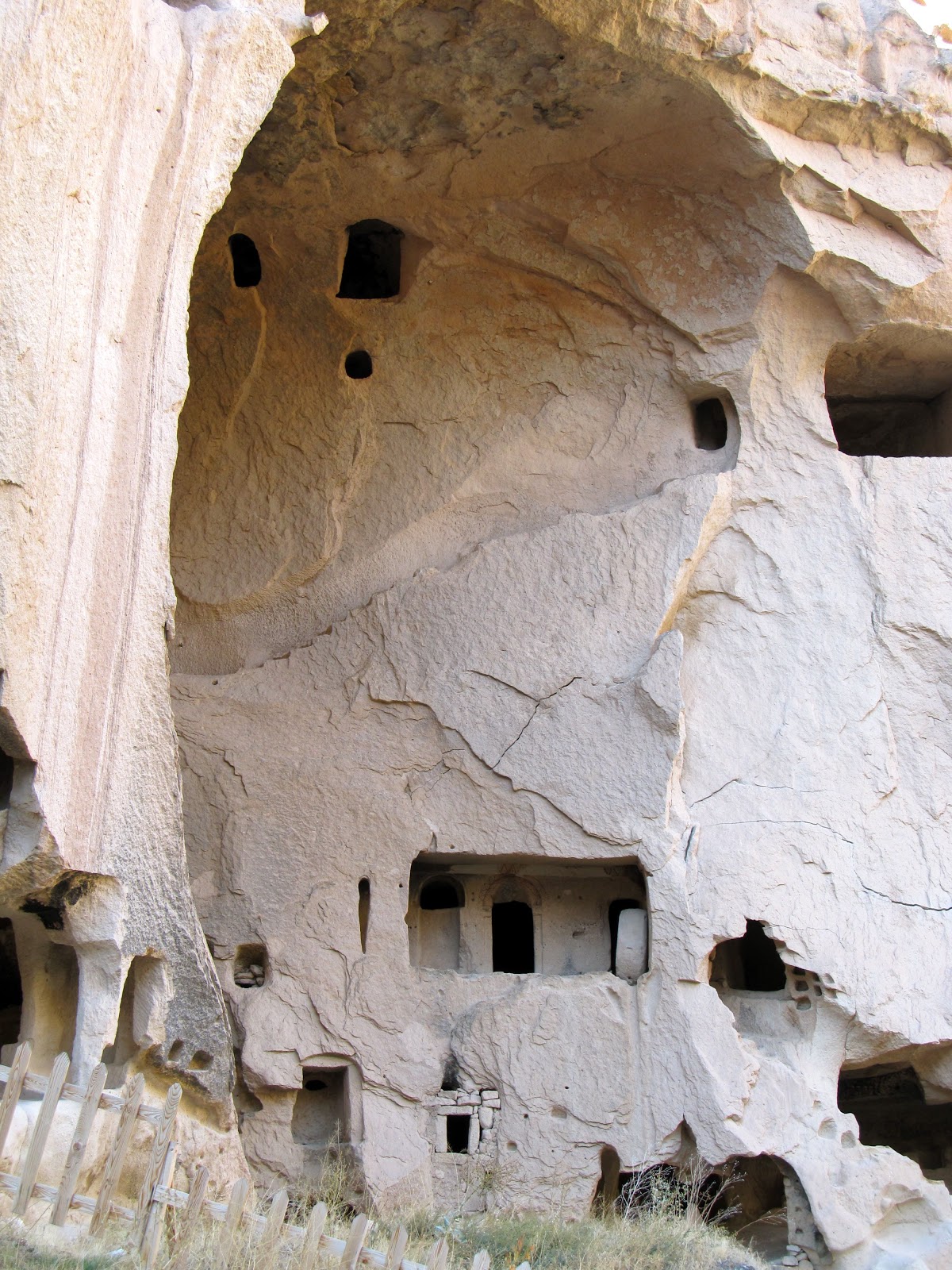
Thursday, after figuring out how the buses run, I returned to Zelve for an afternoon exploration of the cave city and churches. Zelve was built and lived in for several centuries from about 800 to 1200AD. It was finally abandoned because of erosion. In the last 800 years, many of the cliffs containing cave homes have collapsed and subsequently been washed down the canyons. Clearly, in many places just the back wall of the last cave is all that is now exposed to sunlight. Several churches have bits intact, some are only half there, but a couple are in fairly good shape with clear crosses and symbols carved in the ceiling and walls, and a few frescos.

Zelve has a tunnel for about 50 meters through the rock allowing quick access from one valley to the next. It was closed or I would have used the flashlight on my little Turkish cell phone to go through it. Deep in the upper reaches of the third valley, several homes are quite intact, much as they might have been so long ago, with several rooms going deep into the hillside. But across the valley, where the sun is probably brighter, or perhaps it gets more runoff from the hills above, there are great scallops of rock missing, exposing the interior staircases that people once used inside to access upper rooms.

Tuff with sedimentary rock above in Zelve
The geology of this part of Cappadocia is fascinating. For some reason, I had thought the pyroclastic flows were fairly recent, maybe a couple million years old. But in Zelve, the rock that is clearly above the tuff is sedimentary and very thick, indicating that this part at least, was laid down much further back in history, then covered for eons with a lake or sea. The tuff has hunks of basalt embedded in it that were blasted out of the earth with the original pyroclastic flow. Basalt is very hard and difficult to carve, so in places, inside the caves, when a piece of basalt was too large to take out, they simply left it. In one cave there was a grape stomping pit built into the wall with a small hole in the corner for the juice to run out into containers. At the bottom of it there was a large hunk of basalt sticking up which I imagine they stomped around!

Each valley had it’s own wheat grinding stone, driven by donkeys, to serve that village. At the bottom of the three valleys, where their respective streambeds merge, the land flattens out into the river’s flood plain making a rich farmland for these villages. In one church there are paintings of grapes and fish, indicating not only religious connections, but celebrating their primary food sources as well.

Balkan Valley church details
In Ortahisar where I am house-sitting, there is a side canyon called the Balkan Valley that also has some impressive ruins of churches and homes. The first week I was here, I ran into three French people who stiffened up when the dogs approached and then made comments on how they didn’t like nasty filthy dogs. They asked where the churches were and I told them I didn’t think there were any up that valley, which was the truth at the time. Not sure what I’d tell them today…..

The neighbor, Jim, and I hiked into the Balkan Valley and went through all the ruins. One church is nothing more than a small piece of its original self, the rest has caved away and disappeared, but on the ceiling of the alcove are frescos with designs that look almost as fresh as the day they were painted. Other parts of the same church complex are in better shape but there are no frescos to speak of. Some of the carved designs in the walls and ceilings are in great shape. The valley is so isolated and infrequently visited, there’s been very little vandalism or graffiti.

With over 3000 years of continuous human occupation, it’s no wonder these valley walls look like Swiss Cheese. Each little cave, each carved church has a story to tell, but the echos of the stories can barely be heard down the long tunnel of time.

Portions of the village homes in Zelve.


All that is left of an entire church
in the Balkan Valley

Fresco painting on the ceiling in the tiny bit of church
left in the Balkan Valley

Inside the larger church in the Balkan Valley.

Medallions on the walls in Zelve

Nichos inside on of many Zelve churches.

Looking down on Avanos from Zelve

View from deep inside a cave home in Zelve

Large portions of cliff have eroded
leaving the staircase that people once
used inside the home. 


Wednesday, October 31, 2012

Walk to Urgup

Mt. Erciyes, about 12,800 feet in elevation
seen from Ortahisar in Cappadocia.

The plan for the day was to take one of the little buses that run between Urgup and Ortahisar to the “tourist landing”, a place where the tour buses pull off and hoards of tourists walk over the rocks on both sides of the road. The landing is on a ridge just before the road drops down into Urgup . The view must be spectacular. The  volcano, Mount Erciyes, looms up in the east and valleys spread north and south.

On the way to catch the bus, I saw Jim, the neighbor showing off his new motor scooter to Ali and some of the other men in town. I stopped to chat. When Jim left, Ali drew a map for me, showing me the trail to walk to Urgup. Along the way is a trinity of rock churches; part of an old monastery, very isolated. “Probably no one will be there”, he said. Then gave me a cold bottle of water and sent me on my way.

The road going east on the side of the city government building was paved with small interlocking bricks and made for smooth walking for a while. It led down to a carpet emporium, out by itself in the desert, obviously more of a warehouse for the many shops in town than a tourist draw. The road turned to dirt, then a trail.

Late October, the days can be quite warm, and the shadows cool and pleasant. I had my black sweater which promptly came off and was a pain to carry. Drapped over my shoulder bag, it picked up those chubby little ‘velcro’ stickers everywhere I walked. 

Always the poet, Ali told me that after the carpet store I would find the churches with my heart. Actually, I didn’t have to strain that hard. Off to the left was a large rock outcrop towering into the sky, with well-beaten paths leading up to it. I could  see square holes in the rock. The monastery’s location was hardly a mystery.

I was alone, out in the desert, now two kilometers from town. It was quiet. The churches were cut into the rock, deep rooms four and five meters high, with carved columns. Oddly, the roof wasn’t that fragile. In the largest church one of the four columns had crumbled leaving only portions hanging from the vaulted ceiling.

There were three separate churches sharing “walls” with each other, set into a U shape. On the right was the largest, filled with pigeons that roost in the lip of the round half dome and who have left an impressive ring of guano and feathers on the dirt floor directly under it.  The walls had faint remains of what must have been bright and beautiful frescos painted in the dome and other rounded walls.

The church in the middle had two rows of columns spaced closely together. It was deep, and dark towards the back. A few open windows let in light that filtered down through a thick haze of dust.
Look closely, you can see a man
emerging from the corner.

The church on the left was badly damaged with a giant hole in the roof with no evidence of paint or frescos left. However, it does have a unique little sculpture, totally unexpected and unconnected artistically with anything else, carved into the original rock high up at the corner of two walls. It’s a human figure emerging from the wall joint, left leg extended as if running, the right one missing. In one hand it has a spear, in the other appears the faint outline of a sword. There is no face, just a tilted head, but it gives the impression of a feisty warrior emerging from the rock. At the same time, it’s a bit cartoonish, the body is thick with a large belly, the arms and legs thin. What would possess someone to carve that into the walls of a church? And further, the Muslims didn’t destroy it early on. They abhor the idea of a human figure portrayed in a house of worship, lest someone think you are worshiping a human being rather than God. That is what Christians do, and these were Byzantine churches. But this figure bears no resemblance to Jesus or any other biblical personage. It’s an enigma.

After a thorough and silent exploration of the carved churches, I hiked on over the rocks, down ever-narrowing paths until I could see a short mesa in the distance. A car was parked on the top and there appeared to be a few trees, an orchard, or a garden.

A small Turkish man was working in the garden, planting bushes from pots that he had lined up in the shade of some trees. He spoke a smattering of English and invited me to come over and sit. I sized him up. It’s never a good idea to get chummy with some strange man out in the middle of nowhere. I was cautious but he was smaller than me and I probably outweighed him by forty pounds. I wasn’t worried about him as an individual, it’s just that he might think because I was unsupervised by a man, that I was free for the taking. Although he was given to touching me as he gave me grapes off his vines and asking pointed questions like “Where is your husband?” I didn’t get the impression he would do anything forceful. And he didn’t. He grabbed me and tried to kiss me when I was about to leave, and he didn’t intend it to be a peck on the cheek. I made it clear that I was not interested and marched off across the prickly mesa.

Hoodoos
I could see the “tourist landing” in the distance. It took a while to get to it as I was high up with fairly steep cliffs all round. Circling south, I came across a scattering of broken beer and wine bottles. People don’t get drunk in places that are difficult to get to, so at the edge of the cliff there was a narrow path, almost a staircase, between rock faces. I sure didn’t want to go back to that man’s garden and go down the way I’d come up!

At the tourist landing, a man gives rides on his camel while his wife sells cheap trinkets and his children play together on the rocks behind the shop. Across the road, on the other side is a whole shopping center of little vendors with cold drinks, clothing, and food. Giant tour buses have a wide area to park in and the rocks were drizzled with tourists. I crossed the road to see what must be so wonderful.

To start with, the view is fantastic. Mt. Erciyes rises on the other side of the Urgup valley like a big pointed witch’s hat with snow. Small and large farms take up any flat land between the town and the mountain, and up close there were three enormous fairy chimney’s. In geologic terms they are called hoodoos. (Seriously!)

Formed when a thick hard layer or even a chunk of hard rock is above much softer rock, the hard rock weathers at a slower rate and the softer rock is protected. Around the hard rock the soft rock wears away entirely leaving a tower with the hard piece on top. This part of Cappadocia is littered with formations like these. In places there are entire forests of towers.

In this case, the hard rock is lava on top of the tuff laid down ages ago by eruptions from Mt. Erciyes. The lava came from the later eruptions of less bombastic volcanoes.  The three chimney’s at the tourist landing were tall, thick at the base and very dramatic. Further up the rocks were other interesting formations and differing views. 

Constitution Day in Turkey, Oct. 29
I caught a bus into Urgup and had lunch at a little restaurant that advertised stew in pots, baked in a tandoor oven with bread dough wrapped around to seal the pot. What I got was a passable meal, the pot had no bread around it, and the salad was fresh with just a squeeze of lemon instead of dressing. A basket of bread came with the meal instead.

Monday, October 29th was Constitution Day, a national holiday to celebrate Turkey’s becoming a Republic. A huge banner with Ataturk’s picture on it hung from the cliff, the red flags of Turkey waved everywhere and patriotic music blasted from the plaza across the street. School children were out in droves, an official band played while the director sang, and dogs snoozed anywhere people wouldn’t step on them.

The bus back to Ortahisar was packed with noisy teenagers taking advantage of the opportunity for accidental full-body contact as we jostled along the road.

Sunlit column in the least intact church.

The emerging man.