Home again, I am missing the daily activity of exploring a new location, taking pictures of interesting stuff and then writing about it. I came back to the US for the holidays. The last two weeks have been filled with touching base with people, getting back into the home routine which includes cleaning out closets, sorting through three and a half months of mail, wrapping Christmas gifts, etc etc.
I visited with my friend Anna, and told her some of the more amazing aspects of that long trip to Europe. She asked if I'd learned anything. Well, of course! I learned tons about various artists, history, etc, but what has struck me as fundamentally more important are the historical connections that get made when travel takes you to places you've only ever heard of. What a lifetime of thinking, reading, and learning does is make connections in the present moment while standing in front of a painting, or seeing something as breathtaking as St. Peter's Basilica.
What I learned about art in Spain is how much El Greco from the 16th century influenced modern impressionism in the twentieth century. His work and interest in his life was almost forgotten by the time the late 20th century rolled around, but interest revived, and his very modern impressionistic painting strokes were seen in new light and influenced a couple of generations of painters. I had viewed his work in high school, thanks to my Spanish teacher's large collection of art slides, but seeing the giant works in the Prado in Spain meant seeing for the first time, and the similarity of his work to modern impressionists was astounding. It made me go looking for information, it made me curious, and it made me go to Toledo to see his museum.
In Rome, I read a small text next to an ancient sculpture that set off another big connection. The blurb was about the wife of an emperor who was deified after her death and a temple was built for her. The ancient Romans deified people? I thought their pantheon of gods was solid and immutable, but no, they kept adding new ones as people died and others decided they deserved God status. Isn't that what the Catholic church does today, in slightly different form? They sanctify people, who in life were deemed to have accomplished miracles, saved people's lives and who in death, still miraculously heal.
My favorite of the modern saints is Padre Pio, a rather eccentric priest from Petrelcina who was known to go into trances and appear in other locations, sometimes half way round the world. He also suffered terribly from the Stigmata, with almost constant bleeding from the holes in his hands. His following, during life, was extensive, people packed his church when he was giving a mass, as much to receive mass from so unusual a man, as out of curiosity to see if he might fall into a trance and writhe on the floor. The day he died, the Stigmata disappeared and his lifeless body showed no signs of scaring or even healing.
When I told Anna about this interesting historical connection, she said, "Why do you think they call them Roman Catholics?"
Duh.
Travel is a great way to invest in your soul. It takes money, but since you can't take money into the hereafter, travel is the perfect life investment. It forces you to pay attention, live in the moment, learn about other cultures, maybe hone a foreign language or two. There is no better exercise for your brain or spirit!
Showing posts with label Rome. Show all posts
Saturday, December 29, 2012
Friday, December 14, 2012
Postcards from Rome
After Venice, Derek and I rode the train to Rome, arriving late in the evening. We stayed at the same little apartment we'd rented before in Trastevere. It was nice to be "home" again, we already knew where the markets were, and got ice cream at the same great little place with the weird flavors: nutmeg, cardamom, Madagascar chocolate/orange gelatos. The next day we walked to the Trevi fountain, hiked around in the Borghese gardens and went to the Galeria Borghese for which everyone said you had to have reservations far in advance. (In December you can just walk in and purchase a ticket, no lines at all.) Then we walked down the cliffside to the Spanish Steps, then caught a bus "home". A lovely crisp cold day in Rome, the last one together. The next morning Derek flew home and I spent a day alone. I wanted to see the Sant'Angelo tower and museum. Along the way I bit the bullet and bought a few specialty presents like black truffles at the outdoor Christmas fairs. It was a wonderful and relaxing last day for me. So here are some photos of Rome in December:
![]() |
| The Spanish Steps at night |
![]() |
| Crowds in front of the Trevi Fountain. Imagine the density there must be in summer! |
![]() |
| Sea Horse and Merman in the Trevi Fountain |
![]() |
| A street underpass: instead of a long tunnel full of graffiti, it houses a walk-through bookstore!! |
![]() |
| Buildings on the grounds of the Borghese Gardens, love those shaped trees! |
![]() |
| Seahorse fountain (the horses have fish tails!), Borghese Gardens |
![]() |
| Castle Sant'Angelo, with the 2000 year old Roman bridge across the Tevere. The castle was originally the tomb of Emperor Hadrian and his descendants. |
![]() |
| St. Peter's Dome viewed through a portal in the defensive wall of Castle Sant'Angelo |
![]() |
| View to the north from the Castle on a clear day. |
![]() |
| Another view of Rome and surrounding mountains. |
Wednesday, November 28, 2012
Egypt in Rome
![]() |
| In the Vatican Museum |
The Romans loved to collect the best art available in the countries they conquered. Much of the loot came to Rome and has subsequently come back to the light during excavations. Some of it never was abandoned in the first place, it always had a adoring audience.
Clearly the Roman artists were influenced by what they saw and studied of other cultures. Here are some statues of Egyptian women predating a Roman woman, the similarities are striking:
![]() |
| In the Vatican Museum |
![]() |
| In the Augustus museum |
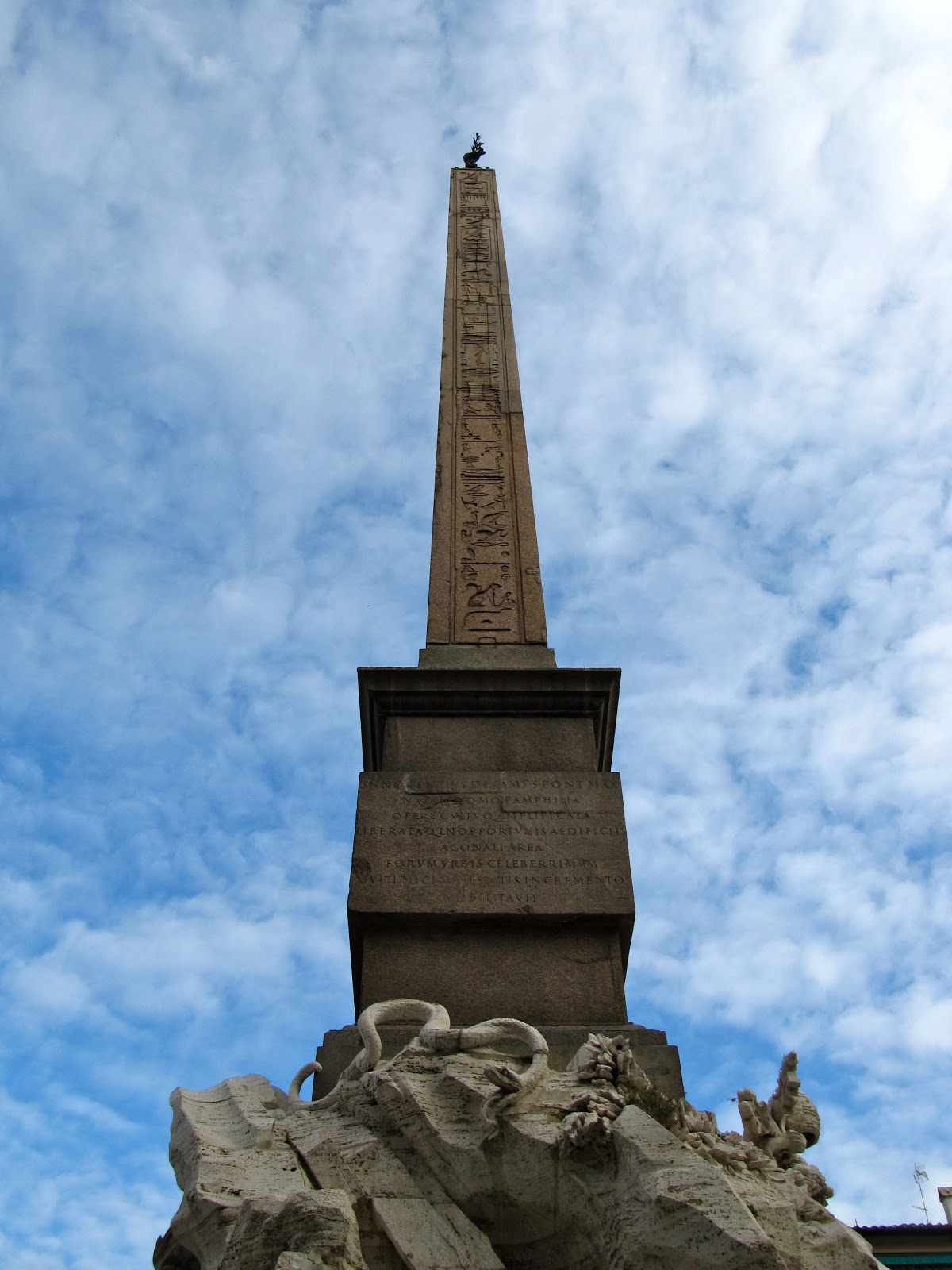
The many obelisks brought from Egypt have ended up incorporated into sculptures, fountains, and the centerpieces of many piazzas. Here are some examples.
![]() |
| Sits atop the Four Rivers Fountain |
![]() |
| Sta. Maria Sopra Minerva Basilica, elephant with obelisk. |
![]() |
| Piazza del Popolo |
In addition, there is a pyramid! It was the tomb of Gaius Cestius, and was built in 12BC. Incorporated into the city walls, it is an impressive edifice, but has no signage or information. Plundered in antiquity, there is no body inside, and very little trace of frescoes either. All the information I got is from the Internet, it's not open, though there appears to be much excavation and archaeological work going on behind it and the Roman wall it is incorporated into.
The Egyptian part of the Vatican museum has a mummy and many beautiful pieces of funerary art. It's an impressive collection, but a bit off the beaten path as most people probably follow the route that leads directly to the Sistine Chapel.
![]() |
| Several sarcophagi in the collection |
Labels:
Egyptian Art,
Italy,
Rome
Location:
Rome, Italy
And yet more fountains
The public works of Rome, many of which date back to 1300-1600 and financed by the Catholic church, are some of the most impressive in the world. In searching for the famous fountains like the Trevi, my friends and I came across many others. Some are hidden like the organic fountain inside the Vatican, visible only with a museum ticket. Others are obscure like the one near the Colosseum, a sheet of rock with ridges, colored by algae and glistening in the setting sunlight. Many are dwarfed by the fabulous attraction they sit next to, and therefore aren't really "seen" by tourists, like the interesting fountain in front of the Pantheon. And one, atop Palatine Hill was once part of Augustus' palace courtyard, and is now filled, not with water, but with flowers.So here are a few more of the wonderful fountains in Rome:
![]() |
| Very modern fountain near Ponte Cavour |
![]() |
| Two Mermen in front of a Roman Temple along Via della Greca |
![]() |
| Ancient 2000 year old fountain pond in the palace of Augustus. |
![]() |
| This boat-like fountain sits at the bottom of the Spanish Steps |
![]() |
| Garibaldi Fountain with porphyry columns |
![]() |
| Organic growth in the middle of a pond in the Vatican. The constant drizzle of water keeps the plants hydrated, eternally. |
![]() |
| Small fountain in a garden somewhere.... |
![]() |
| The marvelous weird fountain in front of the Pantheon. |
Saturday, November 24, 2012
The Romans in Rome
Going on a guided tour is often a mixed blessing. Sometimes a lot is learned and other times a lot of money is spent for very little. At the ruins we joined a tour group to the Colosseum, the Roman Forum, walked up Palatine Hill and saw the Arch of Constantine. The guide inside the Colosseo was excellent. He explained how the building got its name. A colossus is an enormous statue, and there was one in ancient times, a 30 meter high bronze sculpture of the emperor Nero, which was modified into the Sun God, Sol Evictus, as soon as Nero was in his grave. The amphitheater known today as the Colosseum was actually the Flavian Amphitheater and got the name Colosseum due to its proximity to the colossus statue. The circular "playing field" inside was a wooden platform with a maze of pathways and trapdoors underneath for the emergence of combatants and animals. It was covered with sand, called 'arena' in both Latin and Spanish. The sand made for easy removal of blood and body parts, more sand was added for the next performance.
![]() |
| An archeological mix: ancient Roman Forum ruins in the foreground, less ancient Christian churches (left) and the modern monument to Vittorio Emanuel II, the first king of Italy (white building) |
The guide explained that after the Roman Empire began to fall apart, the population of the city dropped to under 20,000 people, and much of the city was abandoned. Regular silty floods of the Tevere eventually deposited 3-5 meters of mud preserving the ruins, but also providing fertile, relatively flat land for farms and eventually new buildings. On the higher land north and east, some buildings like the Pantheon continued to be used as a temple and then a church for two thousand years. Today it is a Basilica of the Catholic Church. The technically innovative and enormous dome is still intact, with a large hole in the top and drainage in the floor where the rain pours in. It was designed this way to reduce the weight the roof must support. Inside are the crypts of various popes and the artist Rafael, as well as impressive sculptures and paintings.
Further to the north and east, there are other large and impressive ruins. One exposed section is the Largo de Torre Argentina, mentioned in an earlier post as the no-kill sanctuary for Cats. Most of these smaller sites are not on the average tourist's radar, but things we tend to stumble across while walking or riding the public transport.
In addition, there are large areas south of the Colosseo and Forum that are full of catacombs and ancient baths. Most of the Roman settlement was on the east side of the Tevere, the Vatican occupies much of the western side along the river. Vatican City was much larger in earlier time, with a surrounding wall, a section of which can still be seen in the Trastevere neighborhood. Compared to the Roman walls and aqueduct systems, it is thin and not very defensible, an athletic teenager could climb right over it.
![]() |
| Long section of Roman wall that kept out invaders and the river at one time. |
![]() |
| Inside the amphitheater, with a small section of platform indicating the "floor" of the arena. Look closely for stairs that once led up to trap doors on the arena's floor. |
![]() |
| View of the Forum, from the Colosseum |
![]() |
| A structure called The Basilica, for which all Basilica Churches are named. This is only one side, it once had a domed ceiling reaching across to an identical structure opposite which is now gone. |
![]() |
| The Arch of Constantine (and me) |
Friday, November 23, 2012
Overpowering emotions
![]() |
| St. Peter's Basilica, seen from one of the bridges crossing the river, |
![]() |
| One of dozens of large sculptures that line both sides of the bridges that cross the Tevere River headed into the Vatican area. |
It was nightfall. Being unfamiliar with the city, we weren't sure what bus to take that might get us back into our neighborhood, Trastevere. (Tras = across, Trastevere = across the Tevere) At the far end of the street we could see the dome of St. Peter's Basilica. Sheila got very excited and said, "It doesn't look that far, let's just go see what it looks like outside". We were all tired and our feet hurt, but we decided to do it.
![]() |
| A woman begging in front of an angel on the bridge. |
![]() |
| Statue of St. Peter in front of the Basilica. |
A choir was singing, music filled the air till is seemed angels flew over our heads. We gestured to the security men that we would like to join the mass and sat on folding chairs at the back. Everywhere, on every wall, covering every inch of floor, there was exhibited the pinnacle of human artistic endeavor, devoted entirely to the human ideal and idea of God. In the soft light, sculptures and paintings by Bernini, da Vinci, Michelangelo, Rafael, and hundreds of others, the best artists of the last two thousand years, sat in niches and formed parts of the nave, the ceiling, the canopy and St. Peter's tomb in the center of the enormous room. High overhead the domes were painted with scenes, the woodwork gilded; they were works of art entirely unto themselves. I had never been inside such an intense concentration of the world's best talent, in any place so profoundly religious, reflecting the desire of human beings for more than this life can provide, the desire for an eternal existence.
It was beautiful and so powerful, it was overwhelming. Tears ran.
Wednesday, November 21, 2012
In Search of Fountains
Of course people go to Rome for all kinds of reasons....to see the Vatican, go through catacombs full of bones (and spiders), visit ancient Roman ruins, and to see sculptures and paintings by some of the world's greatest artists.
I am here with two friends, Sheila and Ann from New Mexico, who have been on a two week trip through Turkey to see the places St. Paul visited. They've come specifically to see the Vatican and to hear the Pope give his weekly blessing. I came to see fountains.
On Sunday, we rode the tram up Trastevere and caught a bus next to some ancient Roman ruins called Largo di Torre Argentina. This square, about a kilometer from the Roman Forum which was the old center of Rome, contained the Pompey Theater where Julius Caesar was killed. The street level of the ruins is about thirty feet below the current street level. Down there amongst the ruins dozens of cats were lounging around. A group of women known as the gattare, the Cat Ladies, formed a no-kill shelter inside the ruins. Over the last twenty years they have sterilized and then set free, more than 30,000 cats. The ruins make an ironically fitting place for the shelter - two of the four Republican temples, built in the first and third centuries, were sponsored by men from the rich family Catalus!!
Ann had the address of the best pizza place in Rome, so we hiked around looking for it, but discovered it closed on Sunday. I had a list of fountains I wanted to see, but limited ideas about where they might be found. We stumbled upon Piazza Navona and lo, there were three incredible fountains inside the huge rectangular plaza. Only after we got home did I realize that one of the fountains I'd been looking for, Fontana dei Quattro Fiumi, the Four Rivers Fountain, had been the magnificent central piece in Piazza Navona! I can't give Rome much credit for signage, there are few signs, and even fewer with English translations.
The map showed the location of the Trevi Fountain, probably the most famous in the world. We traversed narrow streets until we saw signs for McDonalds At Trevi. That world famous restaurant was thankfully not close enough for the Golden Arches to sneak into any photos!
Coming out of the narrow labyrinth of streets, around the corner into the Trevi Plaza, all three of us audibly gasped. The structure occupies the entire side of a marble building and is filled with sculptures, water pouring from the rocks beneath their feet and around the bodies. The crowds were thicker than any place we'd yet visited. Still, it was not the mob scene it must surely be in summertime. We could easily get down the stairs to the pool where we could see it in full splendor without interfering tourist bodies.
It's not possible to fully appreciate the Trevi without some background on all the fountains of Rome and the history of the Roman Aqueducts. The water comes from springs in the mountains to the north east, about eight miles away and to this day is transported via the Aqua Vergine and the even older Aqua Virgo built in 19 BC. The springs were discovered by Roman engineers with the help of a virgin (hence the name Aqua Virgo) and the theme of the Trevi Fountain is the virgin showing the engineers "the way". The name Trevi comes from the confluence of three roads, tre via. Water came into the city and supplied the population with clean drinking water, and led into the baths of Agrippa, serving the population for more than four centuries. Around 538, the Goths destroyed the aqueducts. For the next 900 years, the surviving population had to get drinking water from polluted wells and the Tiber River which served equally as their sewage system.
There was a Roman custom of building a fountain at the endpoint of an aqueduct. Pope Nicholas V had the old water system repaired and in 1453 created a simple large pool where the Trevi now stands. All the fountains of Rome are fed by the same waters flowing through the Trevi, and frequently you will find small fountains with a spigot where the locals get drinking water that is pure and healthy.
In 1629, Pope Urban VIII asked Gian Lorenzo Bernini to design a possible renovation of the fountain, but the Pope died before it could be started. Bernini's sketches survived and though the fountain today is not his design, there are many Bernini touches. In 1730, Pope Clement XII organized a contest which was won by Nicola Salvi and the fountain was completed in 1762 even though Salvi himself died in 1751. The central statue of Oceanus, God of all Waters, is the work of Pietro Bracci and the final supervisor/artist was Guiseppe Pannini.
Post Note: In the post that was sent to subscribers, the Moor's fountain and Neptune's fountain were referenced incorrectly. The labels are correct now. Also more photos were added, taken on a sunnier day.
![]() |
| Detail of the Four Rivers Fountain |
On Sunday, we rode the tram up Trastevere and caught a bus next to some ancient Roman ruins called Largo di Torre Argentina. This square, about a kilometer from the Roman Forum which was the old center of Rome, contained the Pompey Theater where Julius Caesar was killed. The street level of the ruins is about thirty feet below the current street level. Down there amongst the ruins dozens of cats were lounging around. A group of women known as the gattare, the Cat Ladies, formed a no-kill shelter inside the ruins. Over the last twenty years they have sterilized and then set free, more than 30,000 cats. The ruins make an ironically fitting place for the shelter - two of the four Republican temples, built in the first and third centuries, were sponsored by men from the rich family Catalus!!
![]() |
| Largo de Torre Argentina, the no-kill cat sanctuary |
Ann had the address of the best pizza place in Rome, so we hiked around looking for it, but discovered it closed on Sunday. I had a list of fountains I wanted to see, but limited ideas about where they might be found. We stumbled upon Piazza Navona and lo, there were three incredible fountains inside the huge rectangular plaza. Only after we got home did I realize that one of the fountains I'd been looking for, Fontana dei Quattro Fiumi, the Four Rivers Fountain, had been the magnificent central piece in Piazza Navona! I can't give Rome much credit for signage, there are few signs, and even fewer with English translations.
![]() |
| Four Rivers Fountain by Gian Lorenzo Bernini, 1651 |
![]() |
| Fontana del Moro, 1575, with the "Moor" added by Bernini in 1673 |
![]() |
| Neptune Fountain, 1574 |
The map showed the location of the Trevi Fountain, probably the most famous in the world. We traversed narrow streets until we saw signs for McDonalds At Trevi. That world famous restaurant was thankfully not close enough for the Golden Arches to sneak into any photos!
Coming out of the narrow labyrinth of streets, around the corner into the Trevi Plaza, all three of us audibly gasped. The structure occupies the entire side of a marble building and is filled with sculptures, water pouring from the rocks beneath their feet and around the bodies. The crowds were thicker than any place we'd yet visited. Still, it was not the mob scene it must surely be in summertime. We could easily get down the stairs to the pool where we could see it in full splendor without interfering tourist bodies.
It's not possible to fully appreciate the Trevi without some background on all the fountains of Rome and the history of the Roman Aqueducts. The water comes from springs in the mountains to the north east, about eight miles away and to this day is transported via the Aqua Vergine and the even older Aqua Virgo built in 19 BC. The springs were discovered by Roman engineers with the help of a virgin (hence the name Aqua Virgo) and the theme of the Trevi Fountain is the virgin showing the engineers "the way". The name Trevi comes from the confluence of three roads, tre via. Water came into the city and supplied the population with clean drinking water, and led into the baths of Agrippa, serving the population for more than four centuries. Around 538, the Goths destroyed the aqueducts. For the next 900 years, the surviving population had to get drinking water from polluted wells and the Tiber River which served equally as their sewage system.
There was a Roman custom of building a fountain at the endpoint of an aqueduct. Pope Nicholas V had the old water system repaired and in 1453 created a simple large pool where the Trevi now stands. All the fountains of Rome are fed by the same waters flowing through the Trevi, and frequently you will find small fountains with a spigot where the locals get drinking water that is pure and healthy.
In 1629, Pope Urban VIII asked Gian Lorenzo Bernini to design a possible renovation of the fountain, but the Pope died before it could be started. Bernini's sketches survived and though the fountain today is not his design, there are many Bernini touches. In 1730, Pope Clement XII organized a contest which was won by Nicola Salvi and the fountain was completed in 1762 even though Salvi himself died in 1751. The central statue of Oceanus, God of all Waters, is the work of Pietro Bracci and the final supervisor/artist was Guiseppe Pannini.
![]() |
| The Trevi Fountain! |
![]() |
| Oceanus, God of all Waters |
![]() |
| Detail showing the virgin pointing at the spring. |
![]() |
| Detail of woman on the Trevi Fountain facade |
Post Note: In the post that was sent to subscribers, the Moor's fountain and Neptune's fountain were referenced incorrectly. The labels are correct now. Also more photos were added, taken on a sunnier day.
Location:
Trevi Fountain, 00187 Rome, Italy
Subscribe to:
Posts (Atom)