Monday, March 10, 2014

Permaculture and Waterfalls

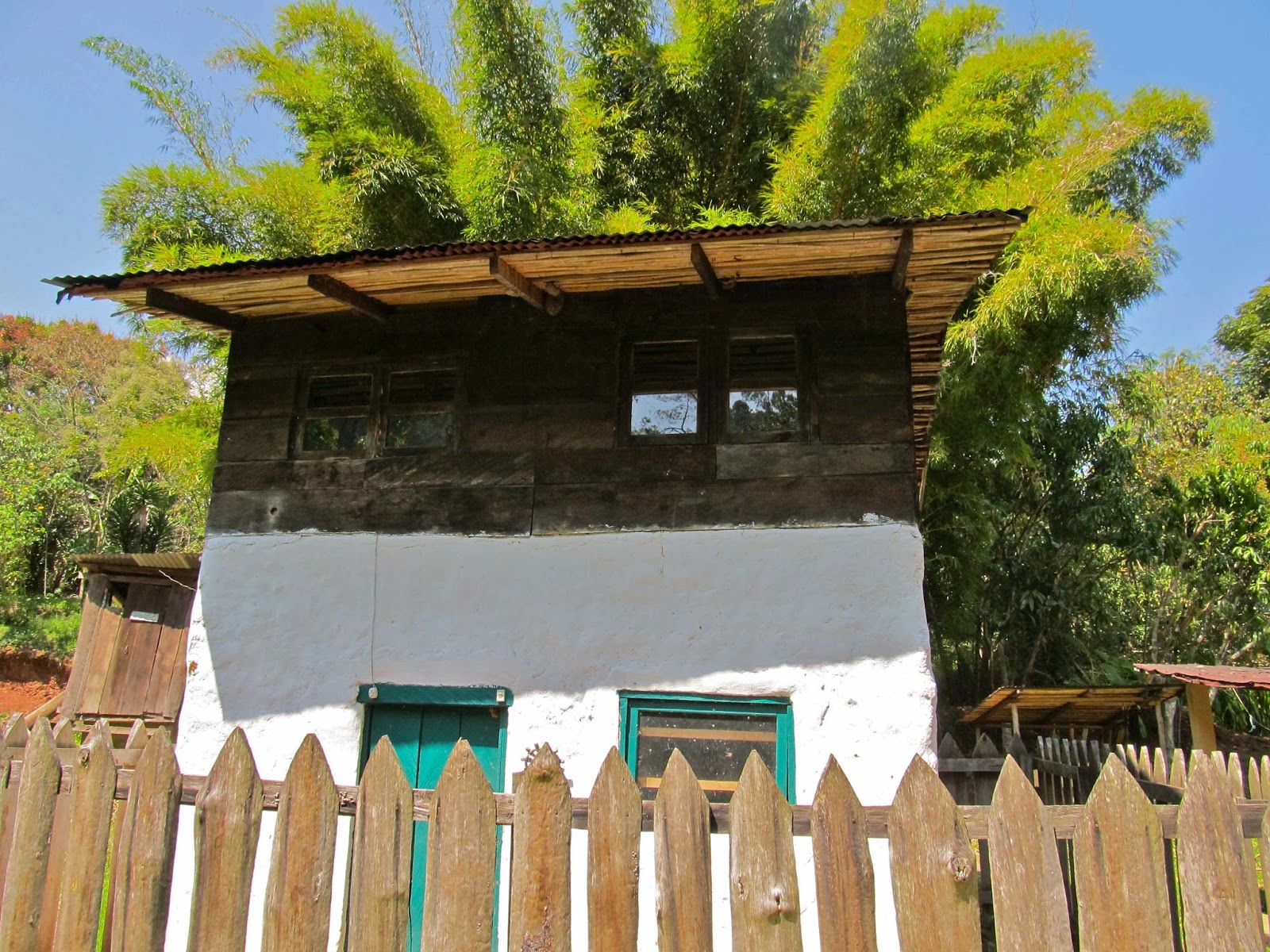
One of many buildings at Ha'Omek'Ka
I don't usually write about the same place twice, but I went back to Ha'Omek'Ka for a couple of days to understand and experience a communal life in a bit more depth.

It taught me a few things. It's uncomfortable to think of my own lifestyle in the US as being out of touch with nature and the reality of nature, but it is. I mean, I do all the suggested "help the earth" things like recycle paper, aluminum, and plastics. I don't drive my car as much as I used to. I compost organic stuff from the kitchen rather than run it through the disposal. I hang my laundry up to dry, I don't even own a dryer. I buy as few processed foods as possible, for my health's sake as well as saving the landfills from excess trash.

But my life, our life, the life in an industrialized place, is NOT in tune with nature. It simply is not.

On the commune, toilets are composting. Access to the toilet is up a flight of stairs. The toilet itself is made of concrete, not porcelain, and is designed so that pee is caught in a cup and drained away, poop goes down into a catchment basin along with the TP. When you finish, you dump a couple of large handfuls of sawdust on top and close the lid. It's rather crude, and a bit stinky, but nothing as disgusting as a forest service outhouse.

People sleep in simple rooms. Mine was in the round concrete bottom portion of a two story building. It was not far from the river. When the river floods terribly, the bottom part may fill with water, but little harm comes of that. It would just need to be cleaned out and dried, then it would be ready to sleep in again. Upstairs was a wooden square room where someone else slept. There were three of these structures in a row, with a toilet building between two of them.
My room was in the center building. The small
house in front is the shower/wash house.


Washing was done at the wash house, which sat off to the side of the three buildings. It was a small wooden structure. Inside was a simple shower with a gas powered water heater hanging on the outside. A concrete sink just outside the door had ribs in the bottom. It served as both a clothes washing sink and for brushing teeth.

On Friday, I decided, even though it was cloudy and a bit chilly that I would bathe in the river. They asked that you wear a swim suit because there are a number of people who don't live on the commune who pass by on the trail. I wouldn't have gone skinny dipping in the daytime anyway!

It was cold. Not freezing, but the kind of cold where you gasp a bit when the first foot goes in and it's just best to dip in as quickly as possible to get the shock over with. Places in the river are deep enough to dog paddle around and it was fun. The current wasn't fast and I had no fear of being swept away.

Up at the wash house, I rinsed off in cold spring water that felt relatively warm after the river, and washed my hair. It was refreshing. The only problem was that the humidity was so high I couldn't get dry, and I continued to get colder and colder until I finally decided to put on my nightgown and get into bed. It was a couple of hours before my feet warmed up.

Meals were served in the dining hall. Cooking was done on wood stoves made of concrete and stucco. It was the most efficient wood powered cooking stove I've ever seen, just a small space for the wood topped by a large metal sheet. Wood was fed into the stove through a hole in the front. That plate got hot enough to boil water quickly and fry eggs in a cast iron skillet. There was also a wood fired oven for baking bread. And they had a traditional gas stove with four burners on top. It wasn't used much because the gas comes in tanks that are quite a chore to carry up the trail to the main road. Plus gas is expensive.

I was under the impression that the community raised all its own food, but that's not the case. As a permaculture farm, plants are interspersed. So along with flowers there were salad greens, vegetables,  and tall red stalks of Amaranth. Vegetables grew in the greenhouse in winter and all over the place the rest of the year. We enjoyed honey from five hives, jams from berries, and fruit from trees growing here and there. Banana plants pop up where ever they wish, so there were always some bananas on the table. Eggs are a regular protein, and are supplied by the dozen chickens living in a large pen with plenty of grass for them to forage. The neighbors grow corn, avocados, and chayotes, so there were locally produced foodstuffs to add to the meals.

The whole point of sustainability is to impact the environment as little as possible. The community is wired with electricity which in Chiapas is fairly cheap, there are five hydroelectric dams in the state. They buy tanks of natural gas for hot water and cooking, but conserve it as much as possible. Water is drinkable, coming from a spring up the hill, and is piped to all the wash houses and the kitchen. They make their own dishes and cups from clay mined on the property. And they have a number of accords, agreements that the residents adhere to. We agreed not to bring anything that creates trash onto the property. No potato chips in plastic bags, soda pop in cans, milk in plastic jugs, etc. Rather than recycle, it is simply better not to accept those products in the first place.

Everything, including human poop is composted and used as fertilizer in the gardens. When the natural grasses dry up, the "straw" is raked and bagged, to be used as mulch and additional composting material in the toilets. Most of the land is natural, with wild flowers and grasses. The plots for growing food are moved every couple of years to let the land recuperate.

The community is vegetarian and the meals were very corn-centric since that is the main cereal crop of the region. None of the local corn is from Monsanto, it is grown from harvested seed. Beans and eggs provide the bulk of the protein needs while several different vegetables with each meal ensure plenty of good vitamins. Everyone seemed healthy, energetic and strong.

Local cascades and lovely park.
Spirituality plays a large role in communal life. People are openly affectionate while maintaining a very respectful demeanor. Once a week they hold a temascal, a sweat lodge ceremony. Rocks are heated in a fire and then brought into a bamboo structure covered with blankets. Water dribbled over them creates steam and people sing songs together while they sweat. In fact there is a lot of singing and music going on. Without TV or radio, people play instruments in the evenings, sing songs and on some nights have language lessons in the local Mayan dialect of Tsetzal.

Many people were in transition while I was there, so I did not see the community if full action. I did see the care and compassion people had for one another. I made a pot in the workshop and left it behind in the hopes that it might be used for soup or sold in the store. I helped Arnulfo a tiny bit with harvesting some coffee beans, and since it had rained so hard, there wasn't much farm work to accomplish.

Arnulfo and I walked two kilometers to the local waterfall attraction. We hiked up the hillside along the roaring cascades and had a lovely time talking about living inside, not outside, of nature. On weekends the place is crawling with tourists, but for us, on a Friday morning, it was heaven.

The community was a wonderful place to hang for a while and gratifying
to see how people can survive well in a sustainable way. Their way of life is doable for centuries, as long as people understand all the principles involved and don't get sucked into outside technology that isn't sustainable.

It is a way of life that human beings will need to go back to when this civilization collapses. Do I sound like a horrible pessimist? Perhaps, but historically no civilization has survived massive corruption, overpopulation, or ecological collapse. It's only a matter of time and it pleases me to see groups of people working to revive nature-compatible ways to continue our human presence in the world.


Monday, March 3, 2014

Permaculture in Mexico

A trail through the community
When I was a teenager, the hippies were a new phenomenon. Now they are ancient history. People born after the 1970s think of them in terms of tie-dyed clothing, LSD, florescent posters, and wild rock music that's now "classic". 

I could never have been a hippie, I was too clean. What I saw were filthy dreadlocked druggies who didn't make any sense when you talked to them. Most of them cleaned up after a while, some went to college, and a few of those people are today's "1%", believe it or not. 

There were several hippie communes near Boulder, Colorado where I lived. I saw them from the windows of the car, filthy trashy places with naked children running around, and people lying under trees too stoned to move. There were sit-ins and demonstrations at the university where it was hard to tell the hippies from the students. I was too conservative to join those anti-war marches, being the marginal Republican on campus in those days. 

My early impressions of communes hadn't changed much even though I have become increasingly liberal.


Arnulfo describing the worm/compost system
My friend Arnulfo, born before WWII, and raised in Hitler's Germany, has lived on numerous communes, or in-community with other people several times in his life. Now he is living on a permaculture farm near Oxchuk, Chiapas. 

His descriptions of the community meant that I needed to revise my thoughts and see what living on a commune is really like. 

This one is run by a couple, Sylviane and Marzo, who purchased the acreage 30 years ago. They are now in their late fifties and are the acknowledged leaders. People who live there pay about $8US for a room and three meals a day with the agreement that they will do their part of the communal work. Some come for a week or so, others have lived in the community for years and have even built their own homes on the property. 

A home is simply a large room. The toilets are communal, as are the meals. Every morning the group decides what needs to be done and who will do it. Meals are made by teams of four people. The rules are simple: no drugs, alcohol, or smoking, no trash left around, and no soap in the river. Organic waste (including human) is composted. It's about as far from my old idea of a hippie commune as it is possible to get. 
Reflective moment beside the river, with dogs....

Did I mention the river? It borders the property on the south and while not a navigable river, it has pools deep enough to swim in. 

The commune eats what it grows with a few added foodstuffs from outside that are purchased locally. Planted in seemingly random fashion are coffee trees, banana plants, corn, amaranth, vegetables, bamboo, potatoes, traditional medicinal plants, and flowers for the bees. The basic idea of permaculture is to have as little impact on the land as possible, and this means food plants and indigenous plants (weeds) live together in the wild randomness that is normal in nature. 

There is a pottery workshop with a potter's wheel and wood fired kiln where they make their own dishes and pots from clay found on the property. Marzo makes silver jewelry and teaches the craft to anyone who wants to learn. Excess honey and coffee are sold in their little store as well as home-made jams, ceramic sculptures, and plant extracts to treat illnesses. 

I went with the idea of visiting Arnulfo but have decided to return and stay two nights. I want to see the community in action during the whole of a day. It is a beautiful setting, with a nice international group of people, I may just have to return for a month or two. It would be a great way to polish my Spanish as that is the only language used by everyone. 

For more information on the community, click this link:  Ha'Omek'Ka


Rickety bridge across the river where there are
several private homes


Home of the founders


One of many houses


Several of the residents have children


View from a rooftop


View down the valley


Thursday, February 20, 2014

Belize: The Mayan Motherland

Artist's idea of Cahal Pech 
The ruins of Cahal Pech are within the city limits of San Ignacio, Belize. We hired a guide (mediocre) who told us that Cahal Pech was the birthplace of the Mayan civilization. Near the confluence of two rivers, it was a major trading center. Other sites developed up and down river, the highest towers of each visible to the next city. He said that Pech meant Great King, but I knew from reading the literature that Cahal Pech means Place of the Ticks, as in ticks that crawl on animals. I asked him about that and he said Pech meant both things. Apparently the Mayan politicians were the same kind of blood sucking ticks we have today!

It turns out that Cahal Pech was a trading center, but certainly not the oldest of the Mayan sites in Belize. People have been occupying the land and ceremonial center at Lamanai since 2500 BC. Coello and Cerros have the oldest pottery to date.

From what is now known from the archeological digs, it would appear that Belize certainly has many of the oldest ruins. Mayan civilization got its start in the lowlands of the Yucatan peninsula, including what is now Belize.

Altun Ha is the most accessible site from Belize City and is frequented by cruise ship tour groups. It is generally packed with people Mondays through Thursdays during the peak season. Found at Altun Ha, in a tomb, was one of the largest solid jade objects ever made, the carved head of the Sun God Kinich Ahau. It resides in the Museum of Belize when it's not on loan to other museums.

Temple mask at Lamanai

From Orange Walk's toll bridge, tourists can arrange for a boat tour to Lamanai, which means submerged crocodile. The tour includes a guide. It is an impressive site with a small museum, nice restrooms, some vendors, and a picnic area. Several of the monuments have enormous masks on both sides of the stairway leading to the top. And the jungle around it is filled with monkeys, butterflies, and birds, including the rare trogan.

Coello is not far from Orange walk and is considered by many to be the oldest in Belize.

On the western edge of the country, there are dozens of sites, many of which are not open to the public, and are only barely excavated.

Xunantunich is right on the border of Guatemala, and a short taxi or bus ride from San Ignacio. There is a hand cranked ferry (for cars!) that crosses the slow moving river. Uphill about a mile is the ceremonial center.  El Castillo rises 39 meters and is the tallest pyramid in Belize. A climb to the top reveals a wide vista of the entire area. It's easy to see the practical aspect of towering platforms. Light signals could easily be sent at night from one city to the next. In addition astronomical studies were performed continuously by the priests. The Mayan calendar is based on astronomy, and due to their precise measurements of the cosmos, the calendar is far more accurate than our modern ones.

Xunantunich
Caracol, the subject of the previous post, has the most intact stelae and consequently the best historical information in Belize. From the carvings, pottery, and monuments, information about the warfare between cities, the lineage of god-kings, kinships, and specific dates are available to those who can interpret the writing.

For anyone interested in the Mayan civilization, Belize should definitely be on the itinerary.


View from El Castillo, Xunantunich


Cahal Pech, the great plaza

Partially reconstructed temple at Cahal Pech

Iguana in the jungle

Saturday, February 15, 2014

Belize: Caracol Ruins

One of the guides we hired on this trip said that Belize was once a colony of the British Empire. The Brits drive on the left, but the Belizeans don't. They drive on what's left.

I've never seen roads in such bad shape throughout an entire country before. I know that various countries and institutions have donated large sums of money to fix the roads but apparently they don't get fixed. I asked a few locals why that was and the word corruption came up often.

Our guide, Selmo, in front of the elaborately
carved facing on one of the larger pyramids.
A group I was leading stayed in the Cayo district, in the town of San Ignacio. The most famous of all the Mayan ruins in Belize is Caracol, south of San Ignacio. It was huge, a major trading center and rival with Tikal in Guatemala. It boasts an observatory with a similar structure to the one at Palenque, and covered about 200 square kilometers in its heyday, with a population of over 100,000 people. It was larger than Belize City with a greater number of people.

Getting there is the problem. We rented a 4x4 Xterra and got a guide to go with us. It was a good thing too, because we'd have never found our way down those many dirt/mud roads without him. We had to be at a military checkpoint no later than 10:30am to be escorted by trucks with armed soldiers. The reason for the escort was two-fold. Several years ago, cars on the way to Caracol were hijacked and robbed by Guatemalans who hid out in the jungle and crossed back and forth over the border at will. No more hijackings have occurred since the military escorts were started. The other more practical reason is that the road is so horrible that it is easy for even a 4x4 to slide off the road into the jungle or down into a streambed. The much larger military vehicles carry rescue equipment and are often tasked with saving tourists from spending the night in the jungle.

One pyramid had a ramp, which was unusual.

Our guide, Selmo, had worked as a young man on many of the seasonal crews that removed trees and debris from the temple mounds. He got very interested in archeology, as the people of Caracol were his ancestors. He was a wealth of information about the site, the birds, insects and animals. He even introduced me to tasty live termites that build their giant wood pulp nests all over the jungle. They taste like sweet carrots and though look like tiny ants, they don't bite.

Caracol was inhabited as early as 1200 BC, but temples and monuments only began around 300 AD. It was abandoned entirely by 1050 AD along with most other Mayan cities in a cataclysmic series of events that included ecological collapse and the overthrow of the god-king political system.

There is a small museum, restrooms, and a little store that sells water and snacks. Nothing is documented so without a guide, we would have just been looking at buildings without a clue as to what they were. As it was, we discovered that Caracol was deeply influenced by Teotihuacan in Mexico, a ruin north of Mexico City with wide influence, yet little is known of it's founders. The cremation of three leaders was done in a style consistent with Teotihuacan and documented on stelae found at Caracol. Later on, Caracol was a subject of Tikal until it grew in power and finally defeated Tikal, reversing the power struggle.

Pools along the river in the national park.
Archeologists are still working there. They have a camp with portable showers, and a mess-tent. Protected under a roof in their camp are a dozen carved stelae with inscriptions.

Surrounding the site is the Chiquibul National Park, a forest of incredible natural biodiversity where unknown species of insects and plants are discovered every year.

In spite of the difficulty in getting there, Caracol and the surrounding park are well worth the effort. It's probably best to go with one of the companies in San Ignacio that will provide a good vehicle and guide/driver rather than try to make it in a regular car or van.

A large administrative complex only partially excavated
Felicia in front of enormous leaves
that are used to wrap tamales. They add an
interesting flavor to the tamales with the steaming process.

Wild green parrot 

Wood fungi, another source of food for Mayans
Selmo demonstrating a hollow tube with a
tobacco-like substance stuffed inside, used as a cigarette

Coral snake, one of many poisonous ones in the jungle. 

Small portion of the ceremonial center of Caracol

More pyramids. We were allowed to climb many of them.

Friday, February 14, 2014

Belize: Actun Tunichil Muknal Cave


ATM cave is known world-wide as the cave of the Crystal Maiden. She was a sacrificial victim left deep in a cave by the Mayans near the village of Teakettle, Belize. The cave is a very popular attraction, and as such may be closed to the public in the next few years if damage to the artifacts continues.

You can visit it ONLY with a licensed guide and with a local tour company. We went with Destiny but PACZ is also highly recommended.

No photos allowed inside,
I took a pic of a tour poster
We also went to Tikal with Destiny. I loved Tikal, but didn’t care for the guide they gave us. He was smart, spoke English, and was well informed as to dates and the subject matter. The problem was that he had some kind of New Age Spirituality agenda that didn’t sit well with six scientific types. For instance Donelo said new studies show that all people in the world are descended from the Maya, that Mayan is the root of all languages in the world,  the Mayans first invented the number zero, and they introduced ideas of heaven and hell to the Vatican. He also talked a lot about higher spiritual planes, energy vortexes, and other new age ideas that may or may not have resonated with the ancient Mayans.

So I asked a perfectly legitimate question: If the Mayans had achieved such a high level of consciousness, why did they engage in human sacrifice? He said it had to do with the blood of Christ (who died quite some time before the first Mayan ceremonial city was built) but got very defensive when I pointed that out.  

All that sounds like a digression, but it leads to the fact that our guide for ATM, Danny, was not only knowledgeable, he offered an excellent reason for the sacrifices, especially when it involved children. And there was no new-age agenda.

The walk in to the cave took about an hour, slogging through slimy mud and muck. We forded the same river three times. Once at the staging area we ate our lunch and then swam into the pool of water at the entrance. The water was “refreshing” as the Belizeans put it. Damned cool, a shock to enter, but we were able to get used to it.

Immediately our headlamps revealed beautiful formations; draperies, stalagmites, stalactites, and flowstone the likes of which I’d never seen. It was full of tiny crystals, and the water had formed little ridges making patterns of small triangular depressions that might fill with water during the rainy season. Danny asked us not to touch certain especially beautiful formations, but the rest of the cave we often needed to touch in order to steady ourselves.
Photos from PACZ tours, taken before the ban.

The river in the cave flowed by with a forceful current, though not strong enough to knock anyone off their feet. All day, until we were deep into the cave, we were at least knee-deep in water and often needed to swim for a few yards.

The rocks were not slippery. Algae doesn’t grow in the dark and that’s what usually makes rocks dangerous. Most of the time we walked on a sandy or pebbly bottom between largish rocks, easily seen with our headlamps. But sometimes the way was blocked by huge angular chunks of limestone that had fallen from the ceiling. Then we had to climb, or slip through very narrow passages that would have made a claustrophobic person scream and run back out the entrance.

One passage involved fitting your helmet through an opening between two giant rocks while turning the head so the neck slid between a flat surface and an angled one. There was plenty of room below for the body but anyone with an exceptionally thick neck might have had a difficult time. The only alternative would have been to climb up and over the boulders, a far scarier option I thought.

The slim passage where you
had to turn your head just so to get through.
The cave is very popular and some groups of people race through it.  A few guides  sign up for two groups a day, one starting at 8am, the other at 2pm. We started into the cave around 10:30 and finally emerged around 5:00. Our guide clearly planned for us to be the last people with the Crystal Maiden. We helped him by being really slow, most of us were over 60.

So while we slogged along walking upstream, we would sometimes step to the side while a group of 20-somethings raced past, laughing and chatting, and then much later, still slogging along, that same group would race by on their way out.

Danny was so meticulous, helpful, and caring. He lent a hand to anyone who needed support, allowed others to hang onto his shoulder while he swam, and practically supported my whole body in one scary drop down the side of a cliff. (It wasn’t scary to anyone else, but I’m petrified of heights.)

He used our waiting times to tell us about the geology of the cave, the ancient people who used it, and to show us obscure places where they’d left things. I doubt any of the racers got such a thorough and deep understanding of the cave. In fact, I’m sure most didn’t as we saw them passing back out with red paint on their faces. They’d been through some whooping and hollering ceremony that may have been their guide’s idea of a human sacrifice re-enactment.  Danny had too much sensitivity and reverence for such nonsense.

About 500 yards into the cave, we stopped and climbed up a cliff onto a platform that was the floor of a cave so large the guides call it the Cathedral. It was dry. The floor was made of flowstone so smooth and fragile that shoes are not allowed inside. We had to wear socks to prevent any human oils from damaging the rock.

Danny described food offerings, and showed us where the Mayans had made fires between three stones, a sacred number representing the first three mountains made by the gods. Some of the pots showed blackened sides and had been used to cook food indicating people probably stayed inside the cave for days at a time. In places the ceiling was blackened from the smoke

All of the pots were broken as the Mayans believed everything and everyone has a spirit that must be released upon its death. The pots were, in essence, sacrificed. One pot in particular had a strange perfectly round hole with no ragged edge, and a tiny slot emerging from one side like a keyhole. Danny told us that some skulls also showed that same kind of hole, but healed up, indicating the Mayans performed brain surgery. Since they also wrapped the heads of royal infants to slope them, the adults may have had headaches and opening up a hole could relieve the pain.

Immediately upon entering the Cathedral there was evidence of human sacrifice. In a hollow on the floor were bones encased in rock. The dry cave isn’t always dry. During the rainy season, water flows over the rocks adding calcium to the bones and pots left behind.  A bit of orange tape surrounded a small u-shaped ridge, all that was left of an infant’s skull. In another place the vague shape of a skull  encased in a thick coat of calcium could be seen. Other places the bones or skulls were merely cemented in place.

Many of these artifacts have been damaged. One skull is missing part of the face because some idiot dropped his camera onto it. Another lost two front teeth when a lens cap fell off, and another skull has a big hole where a tourist was leaning against the wall above it and dislodged a rock. It is up to the guides to keep people inside the boundaries marked with orange tape, but that’s got to be a challenge if the people are young and energetic, and there are eight of them to one guide. The job is doubly difficult when there are dozens of groups going through the cave every single day.

Hence the rules: No cameras allowed inside, no cell phones or electronics, no packs or bags, no food or drink, socks only in the upper chambers, etc. Guides carry a pack, but it has emergency supplies and is water proof. No one else is allowed to carry in anything. In addition, all people going into the cave must be respectfully dressed, in shorts and shirts, no swimming suits or bikinis.

Eventually the total number of visitors may have to be curbed, or the cave closed altogether.

At the very back of the Cathedral cave is a little alcove with the Crystal Maiden. Our guide said the latest archeological measurements have discovered that she is a he.  From the position of the body, it looks like he was struck with a severe blow to the middle of the back and left to die. The middle two vertebrae are clearly smashed. The position he is in is how he must have died, struggling to move, pushing with feet and pulling with his right arm. For years people thought it was a female in a sexual pose.  Another boy, about 14, whose skull had been reshaped as a baby, was left to die, arms tied behind his back and bound to his feet. The bones piled up in a way that suggests that position. 

Other sacrifices in the cave were less intact. Danny pointed out a scattering of bones that indicated the victims had been killed higher up in the cave. The bones washed down before becoming glued to the floor with calcite. All in all there were 16 known sacrifices, and many of them were children.

Apparently as the ecological disaster that ultimately took down the Mayan civilization was worsening (drought, deforestation, soil erosion, climate change) the people began to think the gods had abandoned them and they performed human sacrifices. Finally they resorted to sacrificing the most precious of all, the children. At the bitter end, they lost faith in their god-kings and political upheaval finished off the upper classes. Because they were the only educated people, most knowledge of the Mayan rituals, astronomy, math, and poetry was lost.


We were the last people in the silent cave. When traveling in, the light reflections of other groups illuminated the walls and ceiling. But traveling back through the empty cave, that inky blackness was punctuated only with our small lights.

It was a sad and lonely feeling to have witnessed evidence of the last desperate hopes of people who thought the only solution was to sacrifice children and leave them to die in that deep darkness. They believed all caves to be entrances to Xibalba, home to the gods of the underworld.  It truly was the gateway for those young people tortured and left behind. 

Sunday, February 9, 2014

Belize: Altun Ha

Altun Ha was a Mayan city close to the coast, and important as a stop on ancient trade routes. It's important today as a tourist destination, being the closest Mayan ruin to Belize City.

Belize City is deeply dependent on the cruise ships that stop three to four days a week. I got there on a Monday when no ship had been present for four days. The hunger was palpable. I was constantly bombarded by requests for "a dallah to feed my five kids", and then was latched onto by a man who chatted me up with bizarre lies about being an out of work professor who normally charges $100 an hour to the University. His version of Belize history was colorful to say the least. I couldn't shake him and finally gave him a couple dollars to go away. He was happy with that much reduced "salary".

All the guide books say don't do any of the attractions near Belize City on a cruise ship day, and it is good advice. The tourism bureau has a phone number to call to find out when the big ships will be parked five miles from shore, where they offload tourists by the thousands.

The day we went to Altun Ha we drove in the van that came with our rented house. I can't help but make comparisons to Mexico. The roads in Belize are the worst I've ever seen. But the sidewalks are great, if there is one. The Old Northern Highway shouldn't even bear the name highway. All that is left of the paved road is a jagged strip of asphalt in the middle of a path cleared in the jungle. On both sides are graveled ruts, wet or dry depending on the weather. Heaven help both cars that meet from opposite directions.


Signage is another Belizean problem. There aren't many. And the few that exist are low to the ground, and almost unreadable. We hadn't yet seen a sign to Altun Ha, so we stopped to ask a fellow who was sitting on his porch. In something more like Jamaican English, he indicated it was further down the road. The simple Altun Ha sign was only two feet tall. A kid standing in front of it could have blocked it entirely. Fortunately there were giant tour buses off down a dirt road, we knew we'd arrived.

The site has been well reconstructed and was crawling with Americans and Canadians. They began to clear out after a while and we could climb all over the ruins. Most were in good shape, only one had not been reconstructed. Its fallen blocks had been recycled to build the nearby village of Rockstone Pond.

As Mayan sites go, it isn't big or impressive. But it did have a long path through the jungle, perhaps following an old causeway over a swamp, that led to the "housing" section. That part was unexcavated but visible as large mounds with trees growing out the top. On the left of the path was a large reservoir, the rainwater storage that allowed them to grow to a city of many thousands and survive there almost two thousand years. It also serves the local village today.


Altun Ha was occupied for a very long time. The earliest signs of occupation date to 900 B.C. It was abandoned rather early for Mayan sites, at 1000 A.D. The area is in a "dry" jungle. It is swampy with water seeping from underground but does not receive as much rainfall as other parts of Belize.

The largest pyramid is called the Temple of Masonry Altars. A tomb there revealed jade, shell, and other non-perishable objects including the famous jade head of Kinich Ahau (the sun god), now on loan to an American museum but usually housed in the Museum of Belize.

Unfortunately there was no signage or explanation of the site. There was no museum either. We purchased a booklet and read what the various temples were called and what they'd been used for. It was a great half day trip and introduction to Belizean Mayan ruins.


Trees grow out of the pyramid mounds

Detail of the stonework

Plaza for ceremonies, that had great acoustics.
Temple mounds. The sacred objects would have been
in small thatched buildings on the top platform.

Views from the top

Wednesday, February 5, 2014

Belize, The Land of Dollars

Rusting boat at Caye Caulker. 
Belize is a funny country. Their currency is the dollar, the Belize dollar, which is worth exactly half the American dollar. As a result, all prices are given in dollars. And sometimes you find out to your surprise (and irritation) that they mean the American dollar. It kind of depends on where you are.

At the tourism village, I thought, wow a hamburger for $14.00 Belize (or $7 US). Not bad! Then I discovered my bill for $18 including a drink, was NOT in Belize dollars but in American. Somehow I was supposed to know the tourism village is only for Americans so the prices were American dollars. US dollars are so common and plentiful that they are used everywhere, and given in change regularly.

But thirty miles away, in the Baboon Sanctuary, I expected the $26 dollar fee to rent a canoe for a couple hours would be in Belize dollars. It wasn't!

As it turned out, the $26 (US) was per person, and the canoe came with a paddler/guide who was quite knowledgeable about birds and vegetation. He could spot the tiniest green parrot sitting way up in a perfectly matching green tree from the middle of the river. In the end, with two of us per canoe, the price was worth the experience. (That same guide picked some strangler fig leaves and enticed an entire troop of Black Howler monkeys out of the trees. They were close enough to pet...!)

We rented a house from the VRBO website. It came with a cell phone and a car full of gas. It was a large house with a swimming pool, right on a man-made canal that led directly to the Caribbean Sea less than a block away. The sunrises were stunning every morning.

From this base we were able to drive to Altun Ha (the nearest Mayan ruin), the Crooked Tree Wildlife Sanctuary, the toll bridge on the New River where we rode a boat to Lamanai (another Mayan ruin) and to the Belize Zoo and Baboon Sanctuary (Howlers are called baboons in Belize). We also made a couple of water taxi trips from Belize City to Caye Caulker where we enjoyed great seafood and snorkeling in shark infested waters. (Infested is a good term to describe the dozens of nurse sharks that came up in the shallow water for bits of fish tossed out by the guide.)

And all this fun just cost dollars, lots and lots of dollars. Belize isn't cheap in either currency!


Rare Trogan at Lamanai. We had an
excellent bird spotter as our boat guide.

Our group at Lamanai

Excellent giant carved heads at Lamanai

Jaguar at the Belize Zoo. All the animals are rescued and
cannot be returned to the wild for various reasons. 

Coatimundi at the Zoo

Toucan at the Zoo

Wild and free mama Black Howler and her baby.

Baby howler in the wild

Howlers in the wild at the Baboon Sanctuary


Tarpon at Caye Caulker