Saturday, November 1, 2014

Around Lyon

My friend Joyce and I spent five days exploring Lyon. It's easy to do with its good metro and bus system. We stayed in a hotel near the Gare Part Dieu, the main TGV train station. From there, a number of buses and trolleys run in all directions.

Vieux Lyon, or Old Lyon is west of the two rivers, the Saone and the Rhone. Dominating the area is the beautiful Notre Dame Basilica. Just down the hill a short distance are two Roman amphitheaters, now restored and used in summers for concerts. The subway goes beneath both rivers and quickly takes people from one side of the city to the other.

Roman fountain, Hotel de Ville in background
In Old Lyon, the buildings are ancient stone edifices with narrow streets, mostly closed to traffic now, crammed with shops and restaurants with apartments above. Across the Saone, the town is newer, only several hundred years old. The city, with the Hotel de Ville as it's center, is "downtown." Here, in an old convent, is an impressive art museum that took five hours to explore. The opera house and many wide spacious plaza's overlook the Rhone.

And going east across the Rhone, the city is newer still, extending for miles with modern skyscrapers and industrial zones. It is the third largest city in France.

At a curve in the Rhone, the city has built a beautiful park, Tete d'Or. Many acres of forest, fields and lake are bordered by the river to the west and north, and a large university on the east. It was a beautiful place to spend the day wandering the many paved and unpaved trails.

Elaborate ornamentation of the Hotel de Ville

The Lyon Opera House

Saone River between Old Lyon and the City Center

Looking up at the Notre Dame
Basilica from trails in the park below

Parc de la Tete d'Or

War monument on the island: Ile de Souvenir
Sculpture at the entrance to the park


Lyon: Food Capital of the World

If France has the reputation of being the foodiest country, in terms of variety, cooking styles, and innovation, then Lyon, which all Frenchmen say is the best, is surely THE food capital of the entire world.

And we ate there for 5 days. And ate and ate.....

Fortunately we walked and walked too.

Andouillette!!
Lyon is the third largest city in France. It has a decent metro, augmented by buses, electric trolleys, and two funiculars.

I try to plan trips the easy way. Get where I'm going, plan the next phase on then go. In the autumn, which is off-season, that's easy. The entire trip is more intuitive, and changeable. But it backfired in Lyon. I tried several requests on AirBnB and got zero answers. So we stayed in a hotel found on Booking.com, for one night. It suited us. It had a micro kitchen and was centrally located. We stayed for five days. But having learned a good lesson, we booked the whole rest of France, trains and lodging until the end of our stay.

Inside Notre Dame Cathedral
The first full day we took the metro to Old Lyon, and rode the funicular, which is on the same ticket as the Metro, up to the Notre Dame Basilica. It is almost as spectacular as the one in Paris, but built at a somewhat later time when technology had gotten better and there was no need for flying buttresses. Filled with religious paintings and sculptures, it also has an inlaid tile floor that was impressive. Overlooking the entire Rhone Valley is a golden statue of the Virgin Mary.

Just down the hill is a Roman ruin dating to pre-Christian times. It consisted of two amphitheaters, both restored and in full use all summer as an outdoor music and theatrical venue. The antiquities museum is housed next to it, half buried in the hillside with tubular windows to let in the light. It houses a huge collection of Roman sculpture, rescued frescoes, and inlaid tile scenes.


Amphitheaters

Lyon was once Lugdunum, a major Roman trading post since it was situated at the confluence of the Rhone and Saone rivers. The old city is atop massive roman ruins, buried in part by the annual flooding of the rivers, which are now more or less controlled, and the usual knock-down and build techniques of human beings over the entire planet.

We walked through narrow streets with tiny zooming cars, down into Old Lyon at the bottom of the hill. It was packed with tourists, every restaurant was full with a line out the door. We picked one with a menu in only French and stood in line. Finally we were seated and slogged our way through the offerings. A few fast questions in English and French were asked of the poor sweating waiter who was working hard, dealing with far too many tables. One of the items was andouillette sausage, something I'd read about but didn't remember why it was touted as so wonderful. We bought the midi-lunch, a salad, main course and dessert.

Each course was a meal in itself. Two medium sized boiled potatoes with a very salty fish atop, with sour cream and onion topping, and a side serving of greens almost filled me up. The main course was the sausage, boiled, sitting in a creamy mustard sauce, with a good serving of potatoes au gratin and a puree of carrots. More greens rounded out the real estate on the large plate.

I cut the sausage. It burst open to reveal large chunks of meat, herbs, and steam. It smelled heavenly and it was. Each bite was an explosion of flavors. We ordered a Cote du Rhone red wine to go with the meal. Each sip seemed to cleanse my palate so that every bite of that meal was like the first one.

Then dessert. I thought to order the chocolate mousse, but they were out of that. Instead I was offered a tiny chocolate cake with a dusting of powdered sugar sitting in a pool of caramel. It wasn't a lava cake, but probably the lava cake's ancestor recipe. Gooey and warm inside, almost liquid it was like eating a warm dark chocolate bar with cake texture.

Joyce had a fish en croute with a nice cream sauce in a ramekin. Her salad was Lyonaise, a bed of greens with hunks of baked bacon and a boiled egg, topped with herby dressing. Her dessert was a custard, a bit like flan but loaded with tiny flecks of vanilla.

We hurt. We actually ate too much because it was so good we couldn't stop! And the bill, about $50 for the two of us, didn't hurt at all. We'd kind of gotten used to paying that much in Paris for meals that were only half as good.

Later that evening, I went to a party given by some people I'd met in Los Alamos years before. Freddy and Mariepierre live on the 9th floor of a building overlooking the amphitheater ruins, with views to the east and south down the rivers. Out her large kitchen window, the Notre Dame Cathedral was set like a painting, all lit up with floodlights.

One of their friends is an American who married a Frenchman and has lived for 30 years in France. When I refused food at the party because I was so full from lunch, she eagerly asked where we'd eaten and what. When I told her, she expressed shock and awe. I'd eaten Andouillette and lived to tell about it? She couldn't stand the smell and just the thought of eating intestines grossed her out. I assured her, it was one of the best meals of my life.


Tile floors at Notre Dame


Thursday, October 30, 2014

Paris: The Marais

I am a big fan of slow travel, go to a place, rent an apartment for a week (or a LOT more) and see what is interesting. Plus just meander about and peek into alleys and corners. Any city will have so much more to experience that you'll ever read about in a travel guide or on the Internet.

My friend Joyce and I rented an apartment on AirBnB. The owner was a Canadian woman, about 35 years old, who has lived in France for over ten years. Jane owned the apartment/condo in the Marais neighborhood, but decided to move in with her boyfriend and rent out her somewhat smaller space. It was a large room with a high ceiling. A platform over the kitchen and bath served as the loft bedroom.

The kitchen was a 2-butter, so small that two people crash butts all the time!! But it was well stocked, the knives were sharp, the water very hot and it allowed us to purchase fresh food and make delicious breakfasts. It was a perfect situation.

We arrived mid-afternoon after an all-night plane ride and a weird traverse of Paris' train and metro system. Weird only because we were so tired and it was confusing. Fortunately, we discovered, as we would again and again, that Parisians are lovely, helpful, and polite people. Several times someone who spoke English well came to our aid and rescue.

So our first job was to locate a market and purchase food for a few days. We walked right past the grocery story several times because it looked like a department store with a bakery on the side. The grocery section was hidden in the back!

We wandered around the Marais, which is the 3rd Arrondisement (ah-roan-dees-mont), or neighborhood, out of about 16 total in Paris. Joyce had a packet of cards, each one a different walking tour of Paris. We followed the directions to the Place de Voges, once the home of the king, and then later on Victor Hugo. His home is a museum which we enjoyed very much, as well as a nice meal in one of the sidewalk restaurants under the portal (which I'm sure has a better name in French.)

Place de Voges

Marais is just north and east of the center of Paris. If we'd had a month we could have walked all over it, and found good routes to the Louvre, the Notre Dame Cathedral, etc, but being short on time and foot-energy, we opted to use the metro. One of the best in the world, for a mere 1.50 Euros, you can get from one side of Paris to the other in just a few minutes.

At the northern tip of the Marais is La Republique, a metro station, huge plaza surrounded by expensive stores, and a center of city activity. Down the broad Boulevard du Temple is the Bastille. No longer a prison, nor even a building, it is now simply a monument inside a huge roundabout. But the area bustles with activity, sidewalk cafes, and stores. Centralized shopping areas are like glowing spots on the map with apartment buildings packing up the space in between.

Just around the corner from us was a busy street with nice little restaurants and a wine store where Joyce and the young handsome clerk fell in love. He helped us pick excellent wines for several days straight, then said he wouldn't see us for a few days. We would be gone before he got back, and I swear he had a tear in his eyes when he said he would miss us!!

Monument at the Bastille

Colorful & Tasty Macarons

Stained glass canopy in one of the fancy restaurants

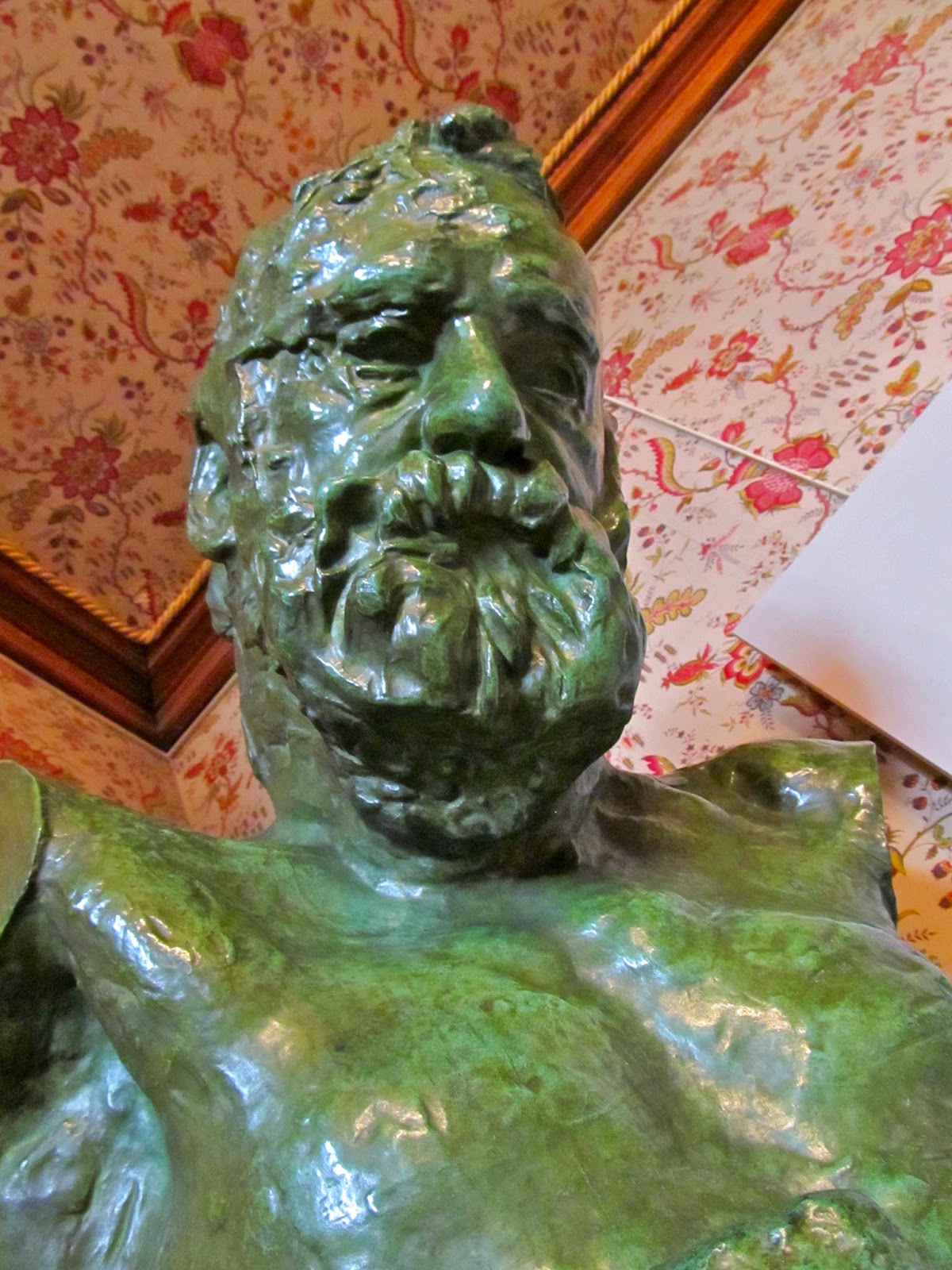
Victor Hugo, by Rodin

Monday, October 27, 2014

Paris: d'Orsay Musuem

Horse at the d'Orsay

Prior to the decision to come to France I’d only heard about the Rodin and the Louvre Museums in Paris. The d’Orsay is THE museum for the Impressionists, the artists I most wanted to see.  There was no disappointment there!

The museum itself is a work of art. A railway station, the Gare d’Orsay was opened in time for the International Exhibition, along with other Paris icons like the Eiffel Tower and the Gran Palais.  By 1939 it was deemed too small to handle the longer trains required by the vast numbers of train riders. It was closed and over the years was used by movie companies as a set, and a mail-train station. By 1970, it was scheduled for demolition. The Directorate of Museums proposed that it become the main repository for impressionist paintings. It was remodeled over several years and finally opened in 1986.

The remodel kept the open train platform “feel” of the building with long structures for sitting in place of the rails. The original ballroom (yes the train station had a ballroom!) is still in use for gatherings, parties, and weddings. The large arching ceiling and enormous clock of the train station lend a grand atmosphere to the main sculpture hall. In salons along the edge of the train hall, the largest paintings are presented, and in smaller intimate rooms on the opposite side are smaller works, many by artists I’d never heard of who were part of the impressionist, post-impressionist, or other artistic movements of the day.

Taking photos was prohibited, but with the prevalence of iPhones I saw many being snapped. Better photos of most of the paintings are available at the d’Orsay website:


or at this Wikipedia page:


As for the collections, I had only heard of Alfred Sisley in passing, and was impressed with the sheer number of his paintings on display in the top-floor gallery. We bought the additional audio guide and were glad we did. So much more information is available that way, as the signs were brief and in French.

Of course the most famous impressionists are also well represented, with the exception of the American Mary Cassatt with only one painting present.

What differentiated the impressionists from the painters that came before were (at least) two brand new ideas. That beauty can be shown without strict adherence to realism, and that reality is an impressive subject. In other words, the real-ness of the world, real people doing normal things, as opposed to a stylized ideal of humanity. The themes represented are not (usually) myths, legends, or biblical stories featuring known characters. A scary painting of people fighting for their lives as their boat crashes among the rocks and people on shore attempt to save them, or a death scene where the family is grieving and the whole range of human emotions are shown in the faces and bodies of those present, were considered valid subjects for painting, and sculpture.

Tourists can buy a Museum Pass, which provides entrance to as many as 30 museums over the course of one, two, or three days. It sounds like a steal, as most of the museum entrance fees are a bit costly. But unless you intend to zoom through each museum with not much more than a cursory glance at the art, it’s not a deal at all. A single big museum a day is my maximum, and the pass costs twice that for just one day.

Sunday, October 26, 2014

Paris: The Rodin Museum


Digging into the culture of Paris, we decided, on a drizzly day to head over to the Rodin Musuem.

I saw the one in Philadelphia, which claimed to be identical to the one in Paris, showing all the same sculptures and history, but the two were not at all identical. In Philadelphia, back in 1984, they had the entire entourage of the Burgers of Callais, whereas there were only small 3-D sketches of the Burgers in the Paris Musuem.

Outside, mounted to a garden wall was the Gates of Hell. A work that had been commissioned, and one that Rodin worked on for several years. From that massive piece, he then went on to enlarge the themes with sculptures of figures from the Gates.

In a glass building, marble portraits and larger full size portraits of people were displayed. Behind the mansion was a lovely garden filled with many of Rodin’s most famous works, like the Thinker, St. John the Baptist, and the writer Balzac.

Inside the building were early works as well as many famous ones like The Kiss. I hadn’t realized how old August Rodin was when he died. He put in over 60 years of work, never stopping until he died over the age of 80. So it was no wonder there was so much to see, and and such interesting transitions as his work became more and more impressionistic.

In addition, and this was a delight to me, there were many pieces from his protégée Camille Claudel.

The movie of her life, Camille Claudel, is one of the saddest movies I’ve ever seen. She was a brilliant sculptor, but because of her sex and expectations of women in the 1800s, she failed to get the recognition she deserved. Rodin took her on as a protégée and as his lover.

Rodin, of course, used Camille as a model, creating a number of pieces that showed her delicate features. In one, the hand of a friend, (just the hand) is pulling back Camile’s hair and the contrast in size of her face with the man’s hand was striking.

Their relationship lasted ten years and finally Camille cut it off entirely, and tried to create her own reputation, disconnected from Rodin. However, she developed a persecution complex, and felt that Rodin was doing things behind her back to discredit her. Eventually her inner turmoil got the best of her and she gave up sculpture forever when she entered an insane asylum. She died at 79.


“The events of my life would fill more than a novel. It would take an epic, the Iliad and the Odyssey, and a Homer to tell my story “I won't recount it today, I don't want to sadden you. I have fallen into an abyss. I live in a world so curious, so strange.  Of the dream that was my life, this is the nightmare.”

Camille Claudel to Eugène Blot, Montdevergues Asylum


Victor Hugo by Rodin


Rodin by Camille Claudel

The Wave by Claudel

St. John the Baptist by Rodin

Saturday, October 25, 2014

Paris: An Overview

Eiffel Tower

Paris: An Overview

A long time desire is satisfied. I am now in Paris, the city of lights and romantic dreams. The only thing missing is a romantic man. Sigh.

However, I am with my good friend Joyce and we are having a wonderful time.

We purchased a two day On-Off pass for the L’Open Tour bus system. I have no desire to see a place through the windows of a tour bus and be told all about it from some guide who asks for tips later in the day. But the double decker bus tours, that appear to be widespread in big cities around the world, are more of an overview of a city, and I’ve enjoyed them in Washington DC, and Edinburgh Scotland. The information about what you’re seeing comes over a loudspeaker or through ear buds. It’s a great way to orient the layout of a city with respect to a river, mountain range, or some big castle on a hill.

We used the bus on Sunday, the first bright sunny warm day. Our pass included the river boats that run up and down the Seine. It was a great day to see the whole city, even some of the modern parts that most tourists never get far enough out to see.
 
Notre Dame Cathedral
My only complaint is that the bus speakers weren’t great and there were times, like parked directly in front of Notre-Dame Cathedral, that the canned tour never even mentioned the world famous site!! Music played most of the time between commentary, and it ranged from traditional French songs, opera, and jazz to country-western tunes sung in French of course. Couldn’t help but remind me there is a city called Paris, in Texas!

Hopping off the boat, we visited the Eiffel Tower. Neither of us wanted to stand in the extremely long line to ride the elevator to the top, but it was fun to hang around, eat an ice cream, and take pictures looking up into the open iron framework.

It was built for the 1900 Universal Exposition and was supposed to be torn down afterwards. Many Parisians felt it ruined the skyline, but its supporters won out. Another pavilion that should have disappeared is the Grand Palais and the Petite Palais, across the street. Both of these beautiful buildings are also now icons along the Seine and the Champs-Elysees

Returning to the center of Paris we went inside the Cathedral. What a feat of Gothic architectural engineering it is. It was one of the first buildings to use the flying buttress, which allowed the walls to hold a towering ceiling above worshipers without collapsing upon them.
 
View from MontMartre
The next day we rode the bus again, this time on the other routes so as to get a feel for just how large Paris really is. South of the Seine is the Luxemborg palace and gardens, the Musee d’Orsay with its huge collection of Impressionist paintings, and the Rodin Museum. North is MonteMartre, the cathedral on a hill. It was an old stone building, but of much more recent construction, not requiring flying buttresses. If it hadn’t been raining a cold and steady drizzle, we might have also enjoyed its extensive gardens. Getting to it was a trip in itself, as the area just below is the sex district with the Molin Rouge and sex toy shops lining the boulevard. We walked back, after the drizzle stopped, to the nearest metro through a neighborhood full of material and sewing shops. Dozens of stores lined the street with every kind of material imaginable.

The bus/boat tour had been a great way to spend a couple of days, one bright and sunny, the other a bit wet. We felt we’d simply “flown” over Paris like a bird with someone pointing out the sights as we swooped around. The next day we dug into Paris deeply, like moles looking for sustenance.
Arc de Triomphe

View of a canal from the Bastille

Tower of St Jaques, where
pilgrims began their journey
on the Camino de Santiago

Thursday, October 2, 2014

The Traveler at Home: State Road 4

Beefsteak Hill
When I first came to this state, I bought Halka Chronic's book, Roadside Geology of New Mexico. Her books were always  informative for us curious people who wanted to know more about the amazing scenes we were driving through.

But the NM book left me upset because one of the prettiest drives in the state wasn't even mentioned, the road from San Isidro north to Jemez Springs, and on to Los Alamos. State Road 4.

I travel this road a lot and remembered a particular hill being referred to as Beefsteak Hill by Dr. John Callender, the geologist who was instrumental in establishing the NM Museum of Natural History. I was a docent there, in the 1980s and went on several docent trips, plus I took a class from Dr. Callender through the UNM in Albuquerque.

Beefsteak hill dominates the landscape north of San Isidro. In the light of the rising sun it is deep red, like a rare steak, but by afternoon, cast into deep shadow, it is just another pretty hill to look at, nothing spectacular. It is the first formation one sees of the deep red sandstone that dominates the scenery further north. I believe it is part of the Entrada Sandstone formation, that was once ocean bottom, laid down during the Jurrasic period, 140 to 180 million years ago. Sitting on top of it, further up the valley, is volcanic tuff deposited from the Jemez Volcano which last exploded just over one million years ago.

State Road 4, as it passes through Jemez Canyon,
Entrada Sandstone topped with volcanic tuff
(No I didn't tweak the colors!)

As the road runs north it passes by Jemez Pueblo and through some of the darkest red rocks on this continent. Just north of the pueblo, there is a visitor's center, and across the highway, the pueblo has built a large picnic and ceremonial area with red cliffs as the backdrop. On weekends, many tribal members sell baked goods, jewelry, and drums at the permanent stalls that line the road. Their round horno bread is light, crumbly, and delicious. It makes the best French toast on the planet, much better than any French bread on the market.

Underneath all these formations lies a band of hot volcanic rock known as the Jemez Lineament. It is the root of all the volcanos that stretch in a line to the northeast from the caldera of the Jemez volcano. The caldera, known as the Valle Caldera, or the Valles Grandes, is a large bowl-shaped expanse of pastureland surrounded by pine forests, just a few miles further up State Road 4.

Along the route, there are hot springs pouring out into the Jemez river, and a couple feed the commercial bath house in the town of Jemez Springs. It's a fun stop if you have time, very funky though, the bathtubs are concrete casts from the 1930s. In addition, there is a soda dam, a barrier of stone that once stretched all the way across the river from one cliff face to the other. It was cut to make room for the road, but the bulk of the dam is still there and you can park and climb around on it. It was created over eons by hot water that dissolved minerals in the rocks and then deposited them once the water emerged from the mountain in a spring. The hot spring is still there, gurgling out on the side of the road, its water now diverted under the pavement.

At the top of the canyon, where the walls narrow, is a formation called Battleship rock. Viewed head-on it resembles the bow of an enormous ship, but from the side, photographed in the setting sun, one can appreciate all the colors created by the different minerals in the volcanic ash.


Battleship Rock, a formation
of volcanic tuff
State Road 4 leads on past La Cueva, a small village with a motel and good restaurant, up onto the flanks of the Jemez Volcano, past the caldera, and then drops steeply down to the Los Alamos National Laboratory. Another fifteen miles leads through open forest and mesa with extraordinary views of the Sangre de Cristo mountains, Santa Fe glittering to the east, and finally ends after a pass through White Rock.

It is a memorable drive, no matter whether you start in White Rock, or San Isidro. Be sure to take your camera. In the fall, the cottonwoods in Jemez canyon can be spectacular with their golden leaves glittering in the afternoon sun.


A little closer view of Beefsteak Hill,
photographed from the town of San Isidro