Tuesday, November 12, 2013

Koh Tao, Island Paradise

South end of Sairee Beach
From Chiang Mai, my friend Rheta and I flew to Bangkok, and then on to Koh Samui, one of three largish islands in the Gulf of Thailand. Koh Samui is not the largest, but is probably the flattest. It is covered with golf courses and has the only airport.

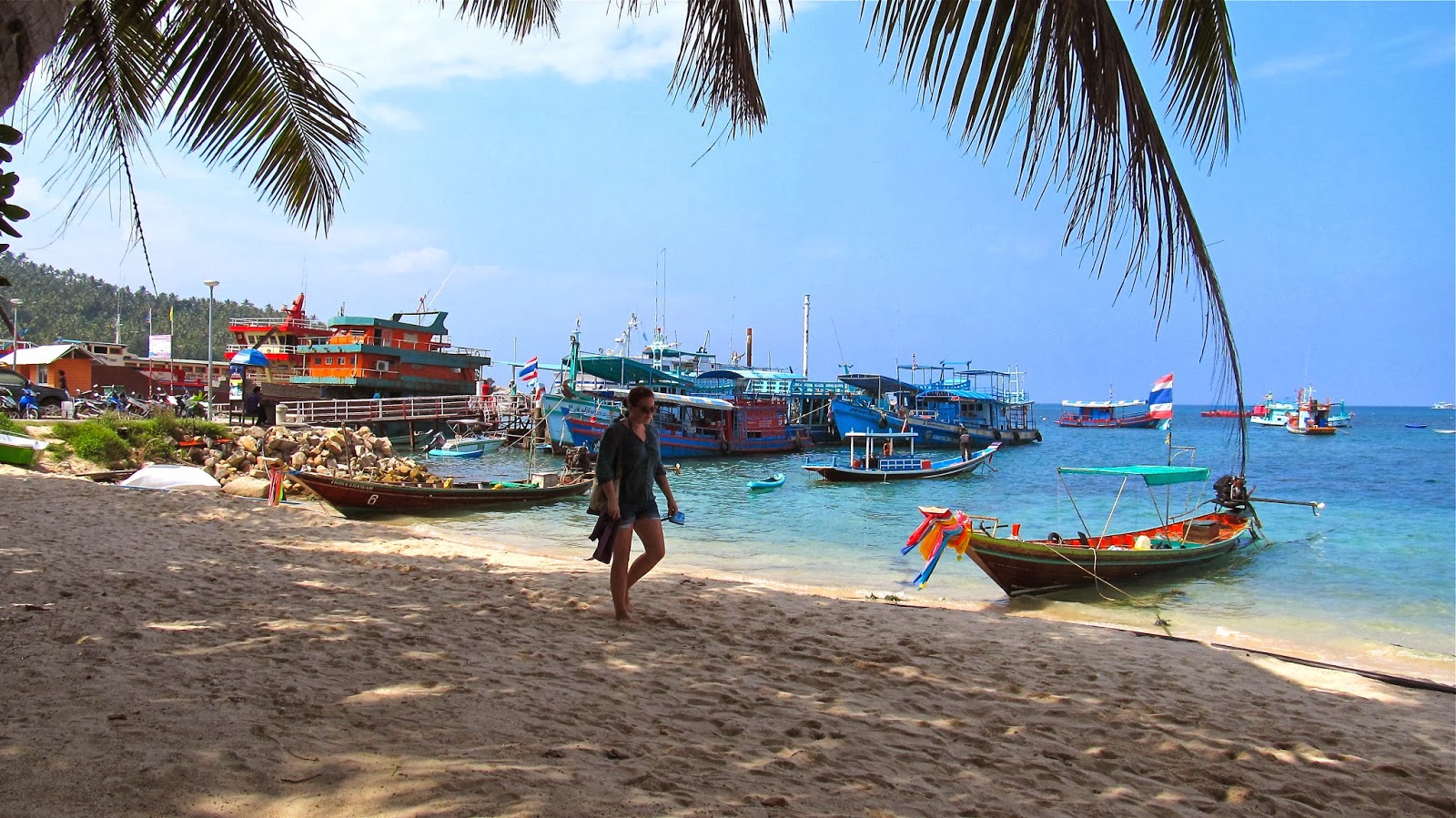
We took an hour and a half long ferry ride to Koh Tao. Rheta's son Darius met us at the port. He has only a motorcycle, but had borrowed a pickup for our short ride from Mae Haad to Sairee Beach where he lives. We stayed at the Asia Diver's hotel, a few blocks from his house.

Koh Tao is the smallest of the three islands, and the one farthest north. Ferries run every day to Koh Samui, Champhon, and other points on the mainland. The island is one long mountain spine with multiple peaks all at about 1000 feet above sea level. Covered with jungle and planted coconut palms, it is a popular spot for divers and snorkelers.

Hunky island scenery
We found the heat and humidity stifling compared to the temperate climate of Chiang Mai. But since it was still the rainy season, the periodic rains cooled things off, and mornings were cool and pleasant until the sun rose. After sunset, the breezes from the ocean brought the temperature down to bearable.

Sairree Beach is both a beach and a town. It's the largest beach, perhaps a mile long, with a reef just a few yards out where the waves don't smash the coral. A large rock outcropping that falls into the sea and cuts the beach in half is the separation of Sairee and Mae Haad.

There is a beach "road" that parallels the ocean with a row of restaurants, bars, and cottages between it and the beach. Not much wider than a sidewalk, it is used by motorcycles and walkers. Lined with shops and restaurants, it is a pleasant hike under shady trees from one town to the next. Further inland is the highway, a two lane road for faster vehicles. Nobody would dare walk next to it for long.

My plan had been to take scuba lessons. Darius has been in Thailand for about 15 years and is a Dive Director. That means he is qualified to teach dive instructors how to teach every level of diving including the deep sea technical stuff. He had a good teacher lined up, but I came down with a head cold. So he sent me to a dive shop where I bought an excellent snorkel and mask.

The first day out, I got a bit sunburned so skipped going the second day. By the way, I never realized what a miracle Aloe Vera is. My sunburn cleared up overnight. The third day we took a snorkel tour on a boat that went round the island stopping at various reefs and bays for some amazing underwater viewing. Our little excursions lasted only about 20 minutes, the rest of the time I could stay in the shade on the boat.

We stopped at different bays and beaches where certain experiences were promised. We would be swimming with sharks at the first stop, but in fact nobody saw one. It was a deep bay with the bottom littered with broken antler coral, as if a bulldozer had gone through. A typhoon destroyed the reef several years ago. We saw very few fish, the little ones had nowhere to hide, and though I was told there really were sand sharks, their coloring kept us from seeing them at all.

Each stop was a new experience. In one crystal clear bay there were hundreds of Sargent fish in schools that parted around us, and the boulders on the sea floor were covered with corals in beautiful condition. Many of the boulder tops were beaten down, by bad weather perhaps, but certainly by the fins of so many snorkelers and divers.
Flowers that pop up all over the island

The boat circled Koh Tao and ended at Nangyuan Island, a hump of land that eroded in the middle leaving a spit of sand connecting the two jungled mountains. On either side, turquoise water lapped onto the white beach.

Privately owned, it cost a bit to go onto the island and a bit more to rent two chairs and an umbrella. The "sand" was roughly crushed antler coral, sharp on bare feet. In the very shallow cove, the rough sand extended under the sparkling water until it reached an area of large boulders that rose up out of the white sand like beautifully placed rocks in a simple graveled garden. Each one was coated with coral and anemones, hundreds of tiny bright fish swam in and out of the miniature caves. In fact that area is called the Japanese Garden and my long time viewing it lead to the demise of my back. I stayed out much longer than I should and for the next three days could barely wear clothes over my seared back. Aloe Vera gel helped a lot but it would cause shirts to stick so painfully I had to shower them off! I so wanted to return and see the garden again, but the sunburn prevented my doing much of anything. Even with a shirt on, the power of the sun caused agony.

Scene just outside the Koh
Samui airport
After the snorkeling day I could fully understand why Koh Tao is the dream island for scuba divers and snorkelers. The island is chock full of resorts, each with its own scuba school. Long-boats with propellers on the end of a ten foot rod could also be rented. The owners were willing to take people anywhere around the island for as long as they wanted. No site was off limits to underwater sightseers.

The beach between the two mountains on Nangyuan Island


A native tree arching towards the ocean,
with a little help from human friends

Long boats (foreground) and snorkeling boats in Mae Haad

Sunday, November 3, 2013

Chiang Mai: In the Slow Lane


The hottest food I ever ate in my life was in a Thai restaurant in Kansas City. It was called Laab Salad. A pile of red (not tinted red, not raw, but chile red) meat piled on top of cabbage was a dish my friend Lester had been told to try. 
Dragon in a Chiang Mai park.

One bite and the top of my head blew off. I could not possibly drink enough water to put out the fire. Lester was beet colored and panting. I thought he might have a heart attack. Water streamed down his face and off the bottom of his ear like a little dripping faucet, wetting the front of his shirt in a long slash.

So when Rheta and I went down the street to a little open-air cafe, I had no idea what to expect. The woman running the place spoke no English but an older man at one of the plastic tables did. He pointed at some bowls and said HotHot. That was enough for me. I pointed to something else. The food was lined up in pots without signs, even in Thai. Only the cook knew what they contained. 

The not HotHot dish turned out to be cold but quite spicy. It had chicken, some vegetables, and came with a pile of rice in the shape of the cup that dumped it out. In addition, we each got a bottle of water and a plate with other cold crisp leaves of unknown origin. 

Against my normal admonitions, I ate most of the leaves. Apparently the Travelers Revenge so prevalent elsewhere is not so prevalent in Thailand where it rains often, washing the plants as they grow. The curry was excellent, and the rice toned down the spicy heat. Our bill arrived; it was almost $3.00 for both of us. 

I was in love with Chiang Mai right off the bat.

Our host told us about the red trucks and how the transportation system works. Within the old city, a mile square chunk of land surrounded by a moat, there are red pickups with camper shells over the back and outfitted with bench seats. We negotiated with the drivers, whose English was usually rudimentary, with a lot of pointing to places on our map. If he agreed to take us there, we’d hop in the back with others on their way to someplace. Eventually we’d hop off, pay him 20 Baht, and be on our way.

A street band playing at
the Saturday Night Market

At the Chiang Mai Gate to the old city, there appeared to be a permanent traffic jam. Most drivers would simply shake their heads if we asked to go there.

On Saturday and Sunday nights there are night markets; streets that are blocked of traffic and fitted out with thousands of tent vendors. We visited the Saturday night market and were astounded at the amount of merchandise available. It ranged from handmade teak frogs with ridged backs that you could “croak” with a little mallet, to the ugliest plastic jewelry from China that would probably break the minute you put it on.

We stopped on a side street where the University of Chiang Mai’s agricultural department was serving ginseng, mango, and other flavors of wine they’d manufactured. For 30 Baht we sampled several kinds and were suitably impressed.

Students from the School for the Blind stood together in little clusters, sang, and played lovely old Thai songs. They also have a massage school and though we never got a massage there, we heard they were exceptional. 

After the reopening of the prison, these monks walked
 home, one of them mindfully texting on his cell phone.
On Sunday, we wanted to get a massage at the Chiang Mai Women’s prison. The prison has a program where they teach the women, who only have a short time left on their sentences, a variety of skills so that hopefully they won’t return. The now-closed prison is in the center of Chiang Mai, and just across the street is a lovely restaurant and massage business run by the women. We signed up for massages at 2:00, and then wandered over to see inside the old prison. Some festivities were going on at the time, loudspeakers had been set up and monks were sitting, lined up in chairs, listening to a speech by an older monk. People brought baskets, decorated like Easter, with sticks coming out, laden with 50 and 100 Baht bills. In the bottom of each basket were various canned and boxed foods that monks might like to eat.

Across the street was a solid jade Buddha we’d seen a couple days earlier at a temple. It was no longer in the bed of a truck, but sitting on a pedestal in the courtyard of a small temple. I assumed the new Buddha was the reason for the celebration, but eventually we discovered it was the reopening of the prison as a public space that prompted all the speeches.

Wandering through the grounds of the prison, we were struck with how decrepit, stiff, and uncomfortable it must have been. It looked like it had been closed up and abandoned for years. Weeds grew out of every crack in the sidewalks, the razor wire was half down along the walls, paint was peeling everywhere, and the doors looked rusted open.

Steven, our host, said it had only closed three months prior. A new prison was built about an hour's drive from the city, and the prisoners are carted back and forth daily. The massages we got there were the best we'd had so far in Thailand. I asked the woman working on me if she enjoyed giving massages, and she said it was much better than in the prison where every day is long and boring. 

The reopening meant the city would now take it over and perhaps create an open space park, or performance center. It covered quite a lot of square meters, and had a sturdy wall to protect whatever they decided to build inside. In a few years, it might be worth a visit just to see what they make out of it.

One morning I woke up early and went for a long walk. There was a nice little temple just down the street so I wandered in to have a peek. It wasn’t closed, but didn’t look particularly open either. By the back door of the temple a little dog sat peacefully waiting. As I took his picture he leaped up and began to wiggle all over. I turned around to see three saffron robed men walking up behind me with trays of food.

I stepped aside and all four of them went into the temple. In a moment, the little dog came shooting out followed by a monk with food for him too.

I took my shoes off and entered the same door. The monks had put one tray on a little stand and were loading it up with small bowls of various curries and vegetables. I looked around, took a few photos of the amazingly bright paintings that covered the walls. They all depicted incidents, real and mythical, of the life of the Buddha. One showed his mother watching as he took his first steps, a lotus blossom appeared under each foot.

I sat in a chair backed up to a wall and just watched the goings on in the room. An older woman came through the front door with a plastic sack containing some food boxes. She knelt in front of the oldest monk who chanted and blessed the food, her, the room, and probably the whole world. It was lovely chanting, quiet and intimate. She unknelt in that graceful Asian way, rising up as if lifted by the air, backed up bowing, then turned to leave. He took the sack, unopened and placed it next to the other trays. Then he and the two monks sat on the floor in front of the large tray and began to eat.

Monks who asked me to breakfast with them.
I finally asked if I could take their picture. The older one spoke some English and asked if I would like to join them for breakfast. It looked like they had more than enough food, but I didn’t know how many other monks were around who might want to eat a bit later on, so I declined.  

It was a sweet morning, people connected with each other on such a fundamental and generous level. The woman who prepared and brought the food, the monks who accepted it and blessed in return, feeding the little dog,
the offer of breakfast to me….With no language barrier, it was simply human interactions happening naturally in a culture that values people more than
stuff. 


The blessing

Wednesday, October 30, 2013

Chiang Mai: Elephants


Advertisements for the elephant camp are all over the old city of Chiang Mai. It gives the impression there is only one camp, but in fact there are several elephant attractions. 

In one of the camps you can sign up to "train" the elephants for a day. You and others will wash it, ride it, send it through its trick-paces, etc. 

A tour to the Maesa Elephant camp includes a ride up and back in an air-conditioned van with an English-speaking guide. Plus the elephant show and an opportunity to see them bathe in the river. For 800 Baht more (about $27), you can ride for 30 minutes down a well-trod trail through the jungle while sitting in a large box atop the elephant. 

Bunches of tiny bananas and sugar cane are sold in front of the animal pens for you to feed the elephants. People attempt to feed one banana at a time but the elephants reach way out with their trunks and take the entire bunch. There is no resisting a snout that is thicker than your arm and ten times stronger. 

Rheta with two pachyderm buddies
They've been taught tricks like reaching up to take the Mahout's hat and place it on your head. They wrap their trunks around you in a big hug and pull you close. The Mahout has his hand out with a 100 Baht bill in it, indicating that he'd like you to give him one also. The elephant is more than willing to take any bill from you and swing it up into the Mahout's hand. 

I'm always a bit reluctant to go see animal performances, as many animals in the world are treated badly and perform under terrible circumstances. 

These were Indian Elephants that have been domesticated for thousands of years. They breed in captivity and there were many young elephants. Each one has its own Mahout.

There was a big sign at the entrance to the park with each of the 72 elephants and Mahouts, photos, and information.  The Mahouts did have a wooden baton with a hook on the end, which they used to give the elephants signals, but I never saw one strike an elephant or mistreat them in any way. That's not to say it doesn't happen.

The animals had big shelters to stay out of the rain, and they relished bathing in the river. I filmed two young ones rolling around, hooting and splashing. The mature elephants behaved like older people—it was nice to be there in the river, but they were not ecstatic.

There seemed to be plenty of hay and clean troughs of water. Although the area was muddy from the rain, it looked like a well-managed place. 

The show was impressive. The elephants played soccer with giant balls that flew out of the stadium when kicked. They still need to work on their aim a bit, but a few goals were scored. Three of them pulled in giant teak logs and stacked them, just like their ancestors did in an earlier line of work. 

And they painted pictures. 

Very smart baby elephant painting a picture.
I read about an elephant that painted in the Chicago zoo. The keeper noticed her drawing lines on the concrete with a wet mop and gave her paper and watercolors. She loves to paint. Her paintings are modern art and sell for quite a bit of money. She also paints what she likes and stops when she finishes. 

These elephants were performing a trick. The Mahout chose the color and brush, crammed it into the elephant's snout and then guided the painting with movements of his hands under the ear as the animal painted. The paintings were the result of a human’s eye, recognizable stems and flowers, hills and sky with a tree, etc. In the gift shop there are hundreds of similar paintings, all of the same three or four images.  The baby elephant’s strokes had a lot of energy, and it painted the most complex picture. It was a very impressive trick, and quite a feat of training. I doubt that it could be done with any other animal.

At the end of the show, the elephants came up to the wooden fence in front of the bleachers for more petting, picture taking, and money giving. I sat on the rail and stroked a young elephant’s trunk as Rheta photographed us. The trunk reminded me of pig’s skin. The Mahout flashed the 100 Baht bill, but my purse was at an awkward angle and I couldn’t burrow into it for my billfold. I raised my hands to show they were empty. The elephant, whose head was right next to me, began to push me into a pole on the other side. I was clearly getting squeezed for money!

On the way back to Chaing Mai, we saw a sign for a place that transforms elephant waste into useful products. The place was named ElephantPooPooPaper. Rheta and I decided that would be the perfect medium should we ever need to write a “Dear John” letter.

Saturday, October 26, 2013

Chiang Mai: Cooking School

It's kind of funny that the only cooking classes I've ever taken in my life have been SE Asian cuisines. VietNamese and now Thai.

The place we're staying in Chiang Mai is owned by a Korean-American named Steven and his Thai wife Ketsuda. They were helpful in telling us what was worth seeing, and organizing the tours for us. We had no more disappointments like the one in Bangkok.

I wanted to take a cooking class, and the area we had walked around had half a dozen schools. Steven recommended Asia Scenic and even paid the bill and arranged the pickup for the next morning. "Don't eat before you go" he warned.

The class started with Miss Indi taking us to the garden in the back to sample fresh leaves of Thai sweet basil, kefir lime, and garlic chives. She had a basket filled with fresh pieces of turmeric (which looks just like orange ginger root), eggplant, taro root, and other SE Asian vegetables.

Miss Indi led us down the street a couple of blocks to a small market called Sompet where the prices are the same for everyone, not higher for tourists. She joked that we needed to stick together, because if we got lost, she might not recognize us, all Farang (foreigners) look alike to her.

At the market we were introduced to the twenty different varieties of rice, all of which were only about 28 Baht per kilo (a little less than one dollar for 2.2 pounds!). The market was typical, a bit stinky from the rotting bits on the ground and the ever present slight sewer odors. Vegetables and fruits were lined up in well organized stalls and the prices were really cheap. Everywhere else in the Old City, I had paid much more, though even those prices were cheap.

Back at the school, which was a large roofed parking lot with a building in the back, we settled down on cushions at a low table and were served a welcome snack; tiny pieces of onion, garlic, mango, chile, and a sweet sauce put inside a folded betel leaf. She showed us how to fold it into a small cone so we could fill it and eat.

There were 8 people in the class, all but one Italian fellow and I had signed up for the half day class. So as a group we decided to make a stir fry, a curry, and an appetizer. The Italian and I made soup and a dessert after they left around 1:00.

I've cooked Thai at home, using recipes from the internet and following instructions on bottles of curry paste, but in this class, we made our own curry paste from scratch.

Made from scratch
curry pastes for green, yellow,
massaman, and red curries
Dry chiles had been chopped and soaked in water for a few hours. Those were the basis of the paste. We had to mince up onions, garlic, green mango, hard tofu and other items that got mashed up with the chiles in a large stone mortar and pestle (similar to the tool in Mexico called a Molcajete).

Paste-making is very time consuming, it's no wonder everybody just buys curry paste in large quantities from the markets.

We each made a stir fry, and cut up vegetables like the long skinny corn in small slices so they looked like yellow stars in the dish. Each person selected a stir fry and a curry from a list of five, so even though we each made our own, we learned to make them all as Indi discussed the differences while we cooked. We each had a wok and a burner, and the meat (a tiny bowl of chicken pieces) was added just after the emotions, the bits that add the most flavor like chives, garlic and chile.

I'm definitely have to get a Chinese Cleaver. It was sharp, easy to use, and had a long enough blade to artistically slice many carrots or chunks of cabbage at once.

After each cooking session, we ate our own dish and sometimes passed the others around for a sample. It was a nice group of people, some cracked jokes, we laughed a lot. Some of us made fried spring rolls and one fellow from the Netherlands was so precise, every vegetable was the same size, and his spring rolls were identical. I had one long skinny roll, and one that looked like a little pig. It all tasted good.

After the group finished up and just the Italian and I were left, I took a longish walk to help digest all the food I'd already eaten, and he did a much more sensible thing, he moved some cushions around, and took a nap.

Then we geared up to make desserts and soups. Again, there was a lot of fine chopping and prepping. The soups took almost no time to make, and in fact the less time the better, as it kept the vegetables nice and crisp. We made batter fried bananas which he gobbled right up, but left his soup. My soup was so good and filling there was no room left for bananas. So my companion Rheta got the leftovers, packaged up in a plastic bag. Both were still warm when I got back to our apartment, and she said (absolutely true too) that it was the best food she'd had so far in Thailand.


Indi demonstrating cooking with vegetable oils.

Monday, October 21, 2013

Bangkok: Three Temples

Reclining Buddha at Wat Pho
While I am no travel rookie, I can still get conned. Rheta and I asked at our hotel, Citadines, for a tour of some temples, specifically Wat Pho, the temple of the reclining Buddha. The hotel had a little tour kiosk right next to the front desk, and a nice man who spoke English booked us a tour. Three temples with a city tour, on an airconditioned bus, with an English speaking guide. It seemed expensive, but then everything in Bangkok seemed expensive.

So we got on the bus, drove around picking up other passengers at their hotels, and finally arrived at the first temple, Wat Traimit. The guide said we had twenty minutes, go on into the temple and look at the solid gold Buddha. He remained in the shade of the little restaurant while we traipsed up the stairs of a beautiful marble temple with a museum on the first floor and the golden Buddha on the second.

Signs in both Thai and English indicated this was the Buddha I'd read about; the world's largest solid gold statue had been hidden under plaster for centuries (to prevent its being stolen) and then rediscovered. There wasn't enough time to see the museum. I asked the guide if this was the plaster covered one but he knew nothing about that story. Apparently he'd never gone to the museum exhibit either. (Read the longer story here if you are interested: GoldenBuddha )

Second place was Wat Pho. There we had a bit more time and were taken to two different temples within the complex; one with a statue similar to the solid gold Buddha where people could sit on carpeting to meditate or pray, and the second housed the enormous and impressive reclining Buddha. The guide was concerned with people taking their shoes off, and talked about the size of the Buddha but he knew nothing of its history or how it was made.

Things are never the same in person as they are in photos. I had no idea the Buddha was so huge. And I wasn't aware of the intricate designs on the soles of his feet. He was covered in gold leaf but his soles were dark stone (I think) with mother-of-pearl inlays depicting numerous scenes. The workmanship was exquisite.

A third place was Watt Benchamabophit, also called the Marble Temple. The main temple housed another golden Buddha in much the same style as the others, but.....it also had a collection of about 50 other statues from around the world.
Fasting Buddha

The transitions in style were interesting. There was a Fasting Buddha that (seemed to me) was a metal version/copy of a very old wooden statue that dates back 2000+ years. I don't remember the details of that old sculpture or where it resides now. It showed a meditating, and starving Sidhartha, before he achieved enlightenment, before a young woman saved him by telling him he would never be able to teach anything if he died. She fed him rice pudding, and afterwards he resolved to keep up his strength in order to continue his search. It was a turning point in his life.

The entire collection revealed how images of the Buddha have changed over the centuries, to reflect the cultures in which Buddhism has taken hold. As the art progressed through time, the Buddha's face became more and more Asian. The Fasting Buddha clearly had an Aryan face and straight hair. It is probably closer to how Sidhartha actually looked. The ears of the Asian Buddhas grew longer and longer through time, and their hair became curly, a sign of wisdom.
I would have loved to hear about that transition, or even details of individual statues, but our guide was nothing more than a highly paid babysitter whose command of English was rudimentary at best. A couple on the van from Texas, said it was the worst tour they'd taken in 30 years of travel.

Expecting to be delivered back to our hotels, we were in for another disappointment. In the van, the guide began a bizarre story about some girl getting pregnant and tossed out of her family, and a boy who was thrown in prison, and how the Government created a factory for them to work in. We finally had to interrupt him to ask about the monuments and buildings we were whizzing past, things he seemed to have no knowledge of, or interest in. So much for the "city tour".

His story was leading up to the fact that we were being taken to a giant jewelry store (the factory) where he assured us he received no commission. Those of us in the back howled that we did not want to go there and the guide said, essentially, we didn't get to choose. At the store, we were assigned a young man to shepherd us along. We assured him we meant no offense to him, but we wanted out and refused to buy or even look at anything. Everyone else on our tour must have felt the same as they shortly ended up at the exit too.  There we were assigned to new vans and then were driven back to our hotels.

There were so many tour vans and so many tourists, the store was so big and fancy, we began to wonder if the city makes it a requirement for all tour companies to end their tours at the "factory". Back at the hotel, the man who sold us the tour asked how it was. We unloaded our "concerns" and told him that no part of his spiel included a visit to a giant jewelry store. He seemed genuinely shocked that we'd been taken there, and then revealed it was his first day on the job. He claimed to know nothing of that tour company. He apologized profusely, but I suspect, unless you take a private tour, or use a guide from Viator (private guides organized through a website) you will end up at the jewelry store.

Later on,  I read about Bangkok tour scams, but no tour company name was mentioned. The advice was to book a reputable tour company. A hotel like Citadines has a fine reputation. I thought any tour sold right next to the front desk would be reputable but, as always, it's "Buyer Beware".


The solid gold Buddha

The Marble Temple

Reclining Buddha's hand holding up his head

Reclining Buddha's toe swirls
Detail of the inlaid designs on the Buddha's feet


Saturday, October 19, 2013

Bankok: Jim Thompson House Museum

Until arriving in Bangkok, I had never heard of the Jim Thompson Museum. It is certainly worth a visit, especially on a day when it's raining so hard the streets flow like rivers and cars float. In other words:  Wednesday.

Silk yarn with silk cocoons in
the background
Jim Thompson, a designer and architect, almost single-handedly revived the ancient village art of silk weaving by sending brightly colored samples to his friends in New York in the 1950s. He became the most recognized and well-known foreigner in SE Asia after he divorced his wife, moved to Bangkok, and began a successful export business. He also purchased five old teak houses, had them dismantled, and reassembled on land he owned, now in the center of Bangkok. It took over a year to accomplish the task, and he didn't move in until everything was finished, including ceremonies to appease the spirits and only after Buddhist monk astrologers picked an auspicious day.

In the garden there is a little house where the spirits, who inhabited the land before the house was built, are presented with food, incense, flowers, water and other tasty beverages every morning. This has ensured over the last 60+ years that the house remains safe from evil and its purpose as a museum and cultural center continues. Read more about it if you are interested at this link:  JimThompsonHouseMuseum

Thompson always wanted his property to become a museum, and it did, though a bit prematurely. He disappeared in 1967 while visiting friends in Malaysia. After extensive searches, no trace of his body was ever found. So his will was executed and the house became one of the most popular non-temple attractions in Bangkok.

Lotus Flowers 
The tour takes about an hour, starting off with a brief walk-through in the gardens and outdoor living spaces. Then, with shoes off in the traditional Thai maner, tours are given of the house itself. Walls tilt inwards in nail-free traditional wooden structures to give strength to the roof. The first floor of a house is actually up a flight of stairs because the house is built on stilts. There are no windows, only shutters that remain open except for times of inclement weather. Photos were not permitted inside, which is a shame (to me!). However, a few photos are available on this webpage: InsideThompsonHouse

The overall feel of the house is one of understated luxury, with silk covered pillows and cushions, finely waxed and carved wooden furniture, and a large lounging couch, customary in Thai homes.


Spirit House in the garden. The squirrels are well-fed
with food offerings.

The main house, note the tilted walls and deep overhangs

Friday, October 18, 2013

Bangkok via San Francisco

Sausalito hills 
It was a long few days getting to Bangkok. Lately, while flying, I find that my legs swell up and I have edema that lasts for a few days. Not only is it rather ugly (I look even fatter with thick ankles and calves) but it is painful and possibly even dangerous. When ankles don't bend and knees are thick, hauling luggage, lifting bags, and just walking long distances through airports can become impossible. I know, I could ask for help with that, get on one of those little electric carts, etc, but I'm not quite ready to admit defeat, or admit to being old....

I'm traveling with my friend Rheta. She has relatives in San Francisco, so we rented an apartment in their complex. It gave us some time to explore, walk a lot, and eat some terrifically good food.

We spent a great deal of time visiting with her son's cousin Bobak (Bobby) and his wife Pantea. They were both born in Iran and came to the US as children but didn't meet until a few years ago, via an Iranian singles website. I knew there was J-Date, the Jewish website. So why not an Iranian one, or an Indian one? I suspect there are Indian websites for each caste and subcaste since marriage outside of one's own cast is rather frowned upon.

Rheta with relatives
They were amazingly well suited to one another. They had a marvelous sense of the absurd, about their own culture and the one they currently live in. And boy did they ever know what to see, and where to eat in San Francisco!

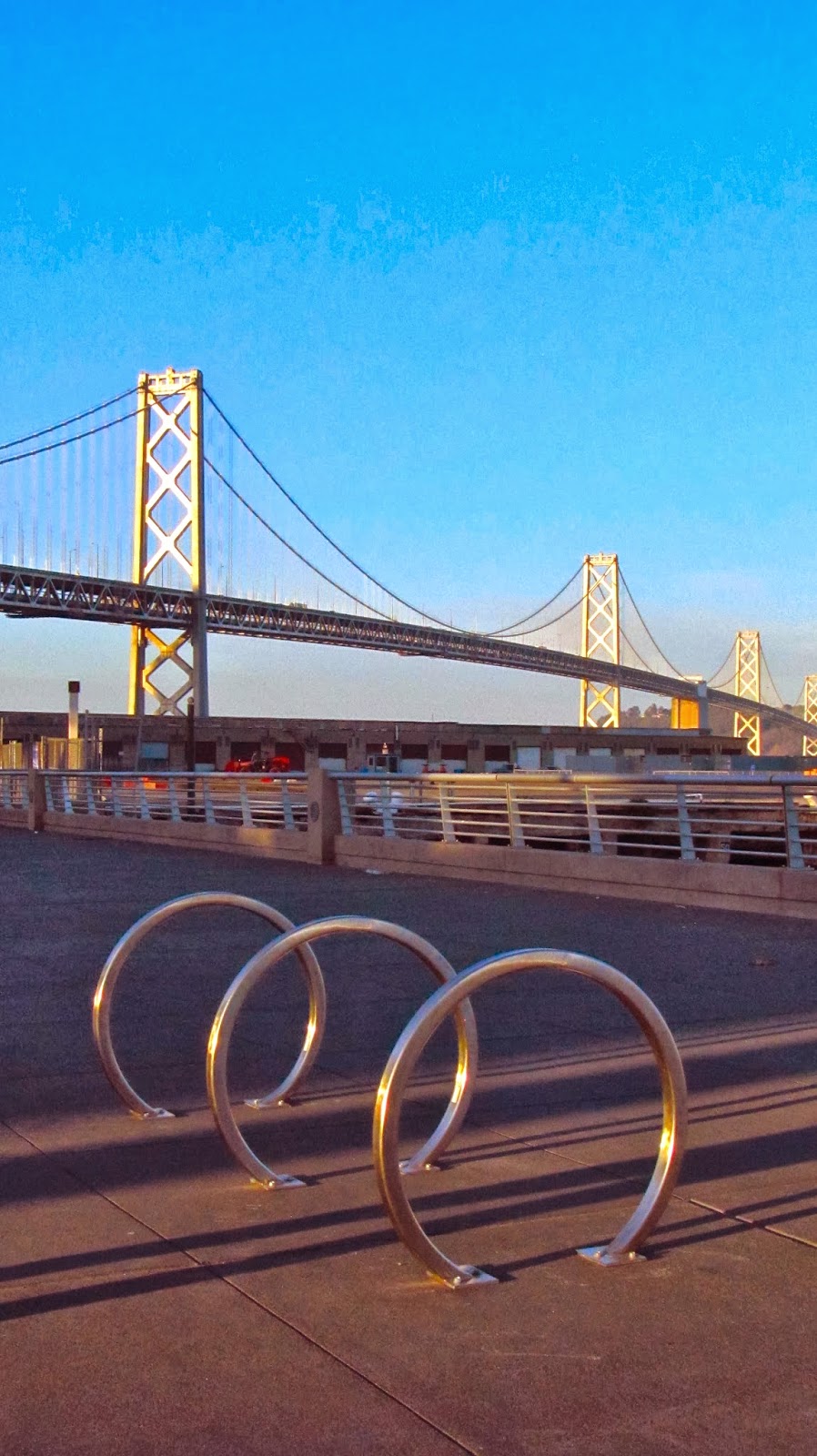
It was pretty easy to figure out the trolleys and the BART system. With only a day and a half, we weren't destined to travel far from the apartment complex, which was just south of the Embarcadero. We walked along the bay-walk, under the bay bridge to the ferry building. It miraculously survived the 1906 earthquake and was the place many people ran toward when the city began to burn; boats were their only means of escape. On Saturdays a giant farmer's market happens there, and across the street is a market of equal size featuring art and handicrafts.

I'm always amazed at how cities self-arrange, how an area becomes an ethnic region, with nothing but a street to divide major and strangely diverse groups. In San Francisco, Columbus avenue is the demarcation line between China Town and the Italian section. One side is filled with dim-sum eateries that stare across the street into pizzarias. And tucked back on a side street is an excellent Iranian restaurant, MayKaday, that just happened to have a table for two when we showed up without a reservation. We feasted on lamb in spinach sauce, chicken, rice pilaf, and then had desserts, a flan-like custard and a rose-water pistachio ice cream. Oh my.

Urban design, bridge
with bike rack....

We took a ferry to Sausalito since neither Rheta nor I had ever been there. It was a beautiful fall day, crisp, a bit windy. Fog hung like rumpled sheets over the hills above the town, but never blocked the sun on the tourists. Rheta had suffered some blisters with her shoes so she purchased a pair of fuzzy house slippers and hung out in a bar while I walked up past the marina and way north to a park where some Zydeco bands were entertaining the townsfolk during a free festival.

Lovely day, a great stopover for the next day's excruciating flight to Tokyo and then Bangkok.


Sausalito's marina


My kind of restaurant, garlicy with a perfect name.